VigorHorse Official Website › Blog › Ashwagandha And The Liver Question
Ashwagandha And The Liver Question
Two published case series describe liver injury linked to an ingredient sold in almost every supplement aisle in the world. Reading them properly means understanding what a case series can and cannot say.
- Ashwagandha has the largest randomised trial file of anything on a typical male vitality label.
- Two published case series, one from Iceland and the US liver injury network and one from India, document liver injury linked to ashwagandha products.
- The reported cases involved standalone extracts at ordinary supplement doses, which means hundreds of milligrams a day.
- A case series describes that something happened. It cannot say how often, because it has no denominator.
- The 2026 hormone meta-analysis found no change in TSH or T3, so the thyroid story that usually travels with this ingredient is not supported.
Why ashwagandha is on so many labels
Because it has evidence, which in this category is unusual. Withania somnifera is an Ayurvedic root with a modern randomised literature covering stress, sleep, exercise performance, fertility and self-rated vitality, and that literature is larger than anything else on a typical male vitality panel.
It is also an adaptogen in the marketing sense, which means it is sold as improving a general capacity rather than treating a specific thing. That framing is commercially useful and it is worth separating from what the trials measured.
What the benefit literature actually measured
Two trials carry most of the weight on a label like this one, and they measured different things in different units.
| Study | What it looked at | Dose involved | What it found |
|---|---|---|---|
| The vitality crossover | Self-rated vitality in men | An extract delivering 21 mg a day of withanolide glycosides | Improvement on a validated questionnaire |
| The fertility pilot | Sperm parameters | 675 mg a day of root extract in three divided doses, 90 days | Improvement on the measured parameters |
| The fertility meta-analysis | Pooled male infertility evidence | Various | A positive direction across a small literature |
| The 2026 hormone meta-analysis | Hormonal modulation across randomised trials | Various | No change in TSH or T3 |
Doses as the abstracts state them. The first two rows are measured in different units because they measured different things.
The vitality crossover used an extract standardised to deliver 21 mg a day of withanolide glycosides and reported improved self-rated vitality on a validated questionnaire. That 21 mg figure is worth noting carefully: it is a small number, and it is small because it describes a standardised active fraction rather than a weight of whole herb.
The fertility pilot used 675 mg a day of root extract in three divided doses across ninety days, and a meta-analysis of the male infertility evidence reads the pooled picture as positive in direction across a small literature.
Why the two dose figures look so different
One is a weight of extract and the other is a weight of a named constituent inside an extract. A product standardised to deliver 21 mg of withanolide glycosides might weigh several hundred milligrams in total. Comparing 21 against 675 directly is comparing a fraction with a whole, and it is the commonest arithmetic error made about this ingredient.
The two case series
The first comes from Iceland and the United States drug-induced liver injury network, and describes patients presenting with liver injury in association with ashwagandha-containing supplements. The second is an independent series from India describing the same association.
Two features of both are worth stating plainly. The products involved were standalone ashwagandha supplements at ordinary label doses rather than exotic preparations, and the picture described was generally reversible once the supplement was stopped.
Neither series claims a rate, neither establishes a mechanism, and neither says the ingredient is unsafe for the population. What they say is that this happened, in identified patients, and that it happened often enough for two separate groups to write it up.
What a case series can and cannot tell you
This is the part that decides how worried anybody should be, and it is a question about study design rather than about the plant.
| A case series | A randomised controlled trial | |
|---|---|---|
| What it is | A collection of individual patients who presented with the same problem | Two groups assigned at random, one of which gets a placebo |
| What it can show | That a problem occurred, in real people, in association with an exposure | That an intervention caused a difference between groups |
| What it cannot show | How often it happens, or in how many people taking the same thing | Anything about an outcome too rare to appear in the sample |
| Why it still matters | Rare harms are almost never detected any other way | It is the right tool for a benefit and the wrong one for a rare harm |
Both designs are doing their jobs. Reading a case series as a rate, or dismissing it for not being a trial, are two versions of the same error.
A case series has no denominator. It counts the people who presented with a problem and it cannot count the people who took the same product and were fine, because those people never walked into a liver clinic.
That is not a flaw in the design. It is the design. Rare harms are almost never detected by randomised trials, because a trial of a few hundred people cannot see something that happens to one in fifty thousand. Case series are how rare harms get noticed at all, and the correct response to one is attention rather than either panic or dismissal.
- Do not read it as a rate. Nothing in either series supports a percentage.
- Do not dismiss it for not being a trial. A trial would not have found this.
- Do note the reversibility. Both series describe recovery after stopping, which is the most reassuring single detail available.
- Do note the products. Standalone extracts at hundreds of milligrams a day, not trace amounts inside a blend.
- Do take it seriously if it has happened to you before. A previous supplement-related liver problem is the best available predictor of the next one.
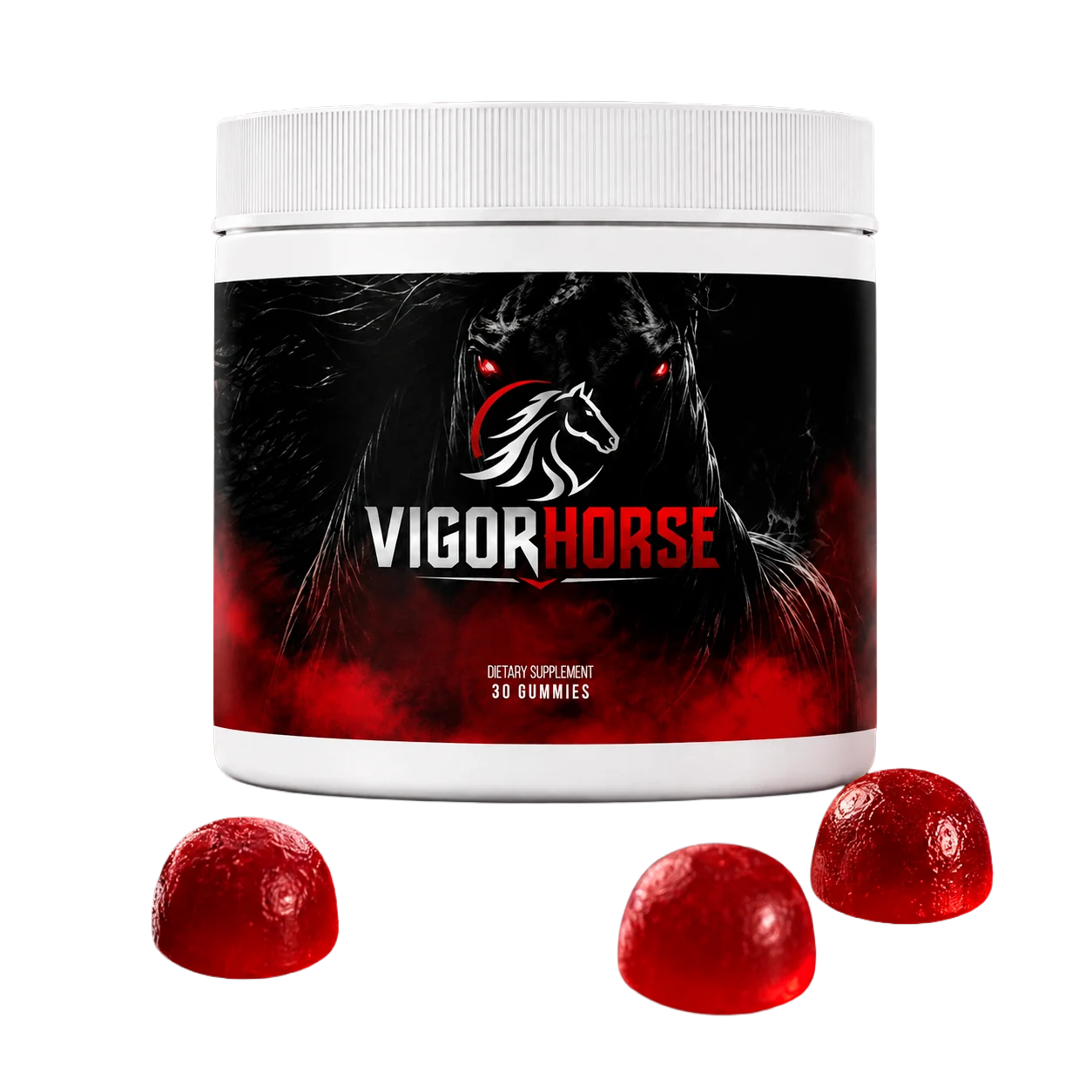
See where ashwagandha sits on the VigorHorse panel
Sixth of 9 names, behind the printed caffeine line, so it weighs 5 mg or less. The whole panel is transcribed on this website.
One jar $89 · six jars $294 · 60-day money-back guarantee
Order VigorHorse On The Official WebsiteOne gummy a day · 30 per jar · lot VIG-26/MY-7014
The doses involved, and how they compare
Every case in both series involved a product where ashwagandha was the point: a standalone extract, taken daily, at the sort of amount a standalone extract carries, which is hundreds of milligrams.
Set that against a shared blend line. A blend total of 82 mg across 9 names cannot deliver hundreds of milligrams of anything, and on a panel that breaks out caffeine at 5 mg, every name printed after caffeine is capped at 5 mg or less.
So the exposure in a blend of this kind is smaller than the exposure in those reports by two or three orders of magnitude. That is a real difference and it is the honest thing to say about it.
A small dose is not automatically safe for every individual. Idiosyncratic liver reactions are, by definition, not neatly dose-dependent in the way a pharmacological effect is. The arithmetic above is a reason for perspective, not a guarantee.
The thyroid story, measured
Ashwagandha is widely discussed in connection with thyroid hormones, usually as a caution and sometimes as a selling point. The randomised evidence has now been pooled.
The 2026 hormone meta-analysis looked at hormonal modulation across randomised controlled trials and found no change in TSH or T3. That is a null result from the strongest available design, and it points in the opposite direction from most of what is said about this ingredient.
The practical reading is narrow. Nothing here supports a product claiming a thyroid or testosterone effect from ashwagandha, and anybody having a thyroid dose adjusted has a reason to mention what they are taking so that nothing gets attributed to the wrong thing.
Who should actually act on this
- Anybody who has had a liver problem linked to a supplement before. This is the one group for whom the case series should change a decision, and the right decision is a different product.
- Anybody taking a standalone ashwagandha extract at hundreds of milligrams a day. That is the exposure the reports describe, and it is worth knowing they exist.
- Anybody having liver enzymes monitored for another reason. Mention it, so a change is not attributed to the wrong cause.
- Anybody having a thyroid dose adjusted. Not because of a measured effect, but because attribution during an adjustment is genuinely difficult.
- Everybody else can treat it as what it is: a documented, rare, reversible association with an ingredient that also has the best trial file on the shelf.
Both things are true at the same time, and a page that printed only one of them would be less useful than one that prints both. The ingredient has the strongest benefit evidence in this category and the only real safety literature in it, and neither fact cancels the other.
References
- Björnsson HK, Björnsson ES, Avula B, et al. Ashwagandha-induced liver injury: A case series from Iceland and the US Drug-Induced Liver Injury Network. Liver Int. 2020;40(4):825-829. PMID 31991029. https://pubmed.ncbi.nlm.nih.gov/31991029/
- Philips CA, Valsan A, Theruvath AH, et al. Ashwagandha-induced liver injury-A case series from India and literature review. Hepatol Commun. 2023;7(10). PMID 37756041. https://pubmed.ncbi.nlm.nih.gov/37756041/
- Fornalik M, Malkiewicz A, Adamczak D, et al. Hormonal Modulation with Withania somnifera: Systematic Review and Meta-Analysis of Randomized-controlled Trials. Planta Med. 2026;92(8):790-805. PMID 41740946. https://pubmed.ncbi.nlm.nih.gov/41740946/
- Lopresti AL, Drummond PD, Smith SJ. A Randomized, Double-Blind, Placebo-Controlled, Crossover Study Examining the Hormonal and Vitality Effects of Ashwagandha (Withania somnifera) in Aging, Overweight Males. Am J Mens Health. 2019;13(2):1557988319835985. PMID 30854916. https://pubmed.ncbi.nlm.nih.gov/30854916/
- Ambiye VR, Langade D, Dongre S, et al. Clinical Evaluation of the Spermatogenic Activity of the Root Extract of Ashwagandha (Withania somnifera) in Oligospermic Males: A Pilot Study. Evid Based Complement Alternat Med. 2013;2013:571420. PMID 24371462. https://pubmed.ncbi.nlm.nih.gov/24371462/
- Durg S, Shivaram SB, Bavage S. Withania somnifera (Indian ginseng) in male infertility: An evidence-based systematic review and meta-analysis. Phytomedicine. 2018;50:247-256. PMID 30466985. https://pubmed.ncbi.nlm.nih.gov/30466985/