VigorHorse Official Website › Choosing a formula
Choosing a formulaChoosing A Male Vitality Supplement
Five questions, asked in order, and the first one sends a good proportion of readers somewhere other than a supplement shelf.
Symptom or preference, what would count as an answer in eight weeks, one ingredient or several, what a label must tell you, and what happens if it does nothing.
A sequence rather than a scorecard, because some of these questions should end the process rather than score it.
Why a sequence rather than a checklist
Five questions in order, any of which can stop the process.
Checklists in this category tend to be scored: eight boxes, a tick in each, a product that gets six out of eight. That format has a flaw, which is that it treats every question as equally weighted and lets a product pass on volume.
A sequence works differently. Five questions in order, each of which can end the process. If question one sends you somewhere else, questions two to five never come up, and nothing about a label matters.
That ordering is the point. A good proportion of the people reading a page like this one should not be buying anything, and a scorecard cannot say so because a scorecard assumes the purchase.
What follows is the sequence this desk would run, in order, with the product this website sells put through it at the end. It fails one of the five, which is stated there rather than smoothed over.
Question one: is this a symptom, or a preference?
Four situations, and the two that end the sequence here.
The first and most important question, and the one a supplement website is least likely to ask. There is a real difference between wanting a routine to feel a bit better, and something having changed that did not use to be like that.
| If this is | Then | And a supplement is |
|---|---|---|
| Something that has changed noticeably, over weeks or months | It has causes worth ruling out once by somebody who can examine you | The wrong first purchase, and possibly an expensive way to delay an answer |
| Something that arrived with a new medicine | The medicine is the obvious first suspect and the prescriber is the person to ask | Irrelevant to the actual question |
| A general wish to tighten up a routine | There is no diagnosis to chase and nothing to rule out | A reasonable small component of that routine |
| Curiosity about a category you keep reading about | Nothing is wrong and nothing needs fixing | A cheap way to satisfy the curiosity, if the cost is small enough |
Only the bottom two rows continue to question two. The top two end here.
This is the one question in the sequence that costs a supplement website money, which is exactly why it is first. A jar bought instead of an appointment is the single bad outcome this category reliably produces, and it is bad because it converts a solvable question into a year of waiting.
Everything below assumes you have answered with one of the bottom two rows.
Question two: what would count as an answer in eight weeks?
Eight weeks, four things to write down, and what it means if you will not.
Ask this before buying rather than after, because an answer decided in advance is evidence and an answer decided afterwards is a memory of what you hoped.
Eight weeks is the right horizon for this category, and it is not arbitrary. The positive trials behind these ingredients ran six to twelve weeks and reported their changes from around week eight. The maca trial ran twelve weeks and reported from eight. The ashwagandha vitality crossover ran eight weeks a limb. The arginine trial that worked ran six.
- Write three countable numbers down on day one. Hours slept on a typical night, training sessions in the past week, drinks in the past week.
- Add one self-rating out of ten for whatever you are actually buying the jar for. Subjective, and still better than a memory, because it is dated.
- Change one thing. A new supplement starting the same week as a new gym membership teaches nothing about either.
- Re-read rather than recall, at four weeks and at eight, writing the new figures underneath rather than over the top.
If you are not willing to do that, the honest answer to question two is that nothing would count as an answer, and a purchase made on that basis will be judged by whatever mood you are in at the end of it.
That is a legitimate place to stop the sequence. It is also why this desk thinks a single jar is the honest first purchase in this category rather than a six-month commitment.
Question three: one ingredient, or several?
The central trade in this category, set out as what each choice teaches you.
This is the real fork in the category and it is usually presented as a question about value. It is actually a question about what you want to learn.
| A single ingredient at trial strength | A multi-ingredient blend | |
|---|---|---|
| What you can check | The label figure against the published protocol, directly | Rank order, a ceiling, and any ingredient broken out with its own figure |
| What you learn if it works | That this ingredient at this dose did something for you | That the product did something. Which part of it is unknowable |
| What you learn if it does not | That this ingredient at this dose did nothing for you | Almost nothing, since no component was at a testable amount |
| Cost and effort | Cheaper per ingredient, more products to buy and remember | One product, one habit, usually a lower total cost |
| Who it suits | Somebody running an experiment | Somebody wanting a routine |
Neither column is the right answer. They answer different questions.
If you want to know whether maca does anything for you, buy maca at three grams a day and find out, because the dose-finding study says 1.5 g a day will not tell you. If you want a daily habit that includes several of the category's names and are relaxed about not knowing which did what, a blend is a reasonable purchase and is usually cheaper.
What a blend cannot be is an experiment. That is the trade, it is a fair one, and the mistake is buying a blend and then reasoning about it as though it were a single ingredient at a known dose.
Question four: what does a label have to tell you?
Four label requirements, in the order most people would actually enforce them.
Decide your own threshold before you read a label, because a threshold set after reading one is a threshold set to whatever that label happened to say.
A complete Supplement Facts panel, at minimum
A marketing ingredient list is not a panel. A panel has serving size, servings per container, nutrition rows where they apply, amounts and Daily Values where they exist. Plenty of products in this category ship without one, and that alone is enough to stop the sequence.
The plant part, where it matters
Root and leaf are different ingredients from the same plant and have different literatures. A label that prints the part is telling you something; one that prints only a species name is leaving it open.
A standardisation figure, where the research used one
Ashwagandha's vitality result was measured on an extract standardised to deliver 21 mg a day of withanolide glycosides. Without a standardisation figure, a weight of whole-herb extract cannot be compared with that trial at all.
Something you can verify yourself on day one
A printed figure for at least one ingredient, a lot on the base and a seal under the cap. Three checks that take under a minute and that a reader can actually perform, which is worth more than a page of certificates nobody can open.
A useful way to calibrate that list: decide which of the four you would actually walk away over. Most people, honestly asked, will walk away over a missing panel and will not walk away over a missing standardisation figure.
That is a reasonable position and it is worth holding deliberately rather than discovering afterwards.
Question five: what happens if it does nothing?
Five things to establish about a refund route before it matters.
The last question, and the one that decides how much money is actually at risk. A product with a genuine refund route is a cheaper experiment than its price suggests; one without is exactly as expensive as it looks.
- Is there a window, and how long is it? A thirty-day window on a thirty-day supply asks you to decide on the day the product runs out, which is before the trial literature says anything happens.
- Does it cover opened containers? If not, it is a returns policy rather than a money-back guarantee, because nobody can judge a daily supplement without opening it.
- Who administers it, and can you reach them? A phone number a person answers is worth more than a form, and a refund route that runs through a marketplace is not the seller's promise at all.
- What does claiming cost? Return postage, tracking, and a trip to a post office. Small against a large order and a real proportion of a small one.
- When does the clock start? Purchase or delivery. If it is purchase, slow carriage comes out of your window rather than sitting in front of it.
Run those five against most of this shelf and the answers are thin. A thirty-day window, unopened only, administered through whichever marketplace the listing sits on, is the common case and it is worth almost nothing.
Which is why this question is last rather than first: it is the one where the differences between products are largest, and it is the one nobody reads.
The sequence run on the product this website sells
Five questions, two passes, one partial fail and one that belongs to the reader.
Turning the method on the jar is the only thing that makes a guide like this credible, so here is the whole sequence applied, including the question it fails.
| Question | The answer for this product | Pass or fail |
|---|---|---|
| One: symptom or preference? | Unanswerable from here. It belongs to the reader, and the top two rows of that table end the sequence regardless of what any jar says | Reader's call |
| Two: what counts as an answer in eight weeks? | A 60-day window from purchase covers a first jar and almost all of a second, which is the eight-week horizon almost exactly | Pass |
| Three: one ingredient or several? | Several. 9 of them, sharing one 82 mg total, so this is a routine rather than an experiment | Depends on the answer you gave |
| Four: what does the label tell you? | A complete panel, one broken-out figure at 5 mg of caffeine, a lot and a seal. No standardisation figure on the horny goat weed and no per-name amounts | Partial fail |
| Five: what happens if it does nothing? | 60 days from the date of purchase, opened jars included, administered by a desk with a phone number, return postage on the buyer | Pass |
Assessed against the label artwork and the seller's own pages, read on 19 September 2026.
The partial fail on question four is the honest result and it is not close. The panel is complete and the blend format means no per-ingredient amount exists, so anybody whose threshold at question four is a figure against every active should stop there and buy a single-ingredient product instead.
The pass on question five is the strongest thing about the purchase. A 60-day window on a 30-day jar, covering opened jars, is longer than most of this shelf offers and it lines up with the trial horizon rather than falling short of it.
Running this sequence on anything else
The same five questions, on anything else in the aisle.
Nothing above is specific to one jar. The sequence works on any product in this aisle and on a good deal of the wider supplement shelf, and it takes about ten minutes.
- Question one is the same everywhere and is the one most often skipped.
- Question two changes only in its horizon. Eight weeks suits this category; a different category has a different clock.
- Question three applies wherever a blend and a single ingredient compete, which is most of the shelf.
- Question four is where your own threshold does the work, and it is worth writing down once rather than re-deciding at every label.
- Question five is where the largest differences between sellers hide, and it is the cheapest question to answer because the policy page is usually two clicks away.
A product that survives all five is not thereby proven to work. It is a product whose claims you can check, whose amounts you can compare, and whose money you can get back if it does nothing.
In this category that is a meaningfully higher bar than most of the shelf clears, and it is about as much as a reader can establish without a laboratory.
Who publishes these VigorHorse checks, and what they cite
The trials the eight-week horizon and the dose thresholds come from.
- Cui T, Kovell RC, Brooks DC, et al. A Urologist's Guide to Ingredients Found in Top-Selling Nutraceuticals for Men's Sexual Health. J Sex Med. 2015;12(11):2105-17. PMID 26531010. https://pubmed.ncbi.nlm.nih.gov/26531010/
- Srivatsav A, Balasubramanian A, Pathak UI, et al. Efficacy and Safety of Common Ingredients in Aphrodisiacs Used for Erectile Dysfunction: A Review. Sex Med Rev. 2020;8(3):431-442. PMID 32139335. https://pubmed.ncbi.nlm.nih.gov/32139335/
- Petre GC, Francini-Pesenti F, Vitagliano A, et al. Dietary Supplements for Erectile Dysfunction: Analysis of Marketed Products, Systematic Review, Meta-Analysis and Rational Use. Nutrients. 2023;15(17). PMID 37686709. https://pubmed.ncbi.nlm.nih.gov/37686709/
- Barbonetti A, Tienforti D, Antolini F, et al. Nutraceutical interventions for erectile dysfunction: a systematic review and network meta-analysis. J Sex Med. 2024;21(11):1054-1063. PMID 39279185. https://pubmed.ncbi.nlm.nih.gov/39279185/
- Gonzales GF, Córdova A, Vega K, et al. Effect of Lepidium meyenii (MACA) on sexual desire and its absent relationship with serum testosterone levels in adult healthy men. Andrologia. 2002;34(6):367-72. PMID 12472620. https://pubmed.ncbi.nlm.nih.gov/12472620/
- Dording CM, Fisher L, Papakostas G, et al. A double-blind, randomized, pilot dose-finding study of maca root (L. meyenii) for the management of SSRI-induced sexual dysfunction. CNS Neurosci Ther. 2008;14(3):182-91. PMID 18801111. https://pubmed.ncbi.nlm.nih.gov/18801111/
- Lopresti AL, Drummond PD, Smith SJ. A Randomized, Double-Blind, Placebo-Controlled, Crossover Study Examining the Hormonal and Vitality Effects of Ashwagandha (Withania somnifera) in Aging, Overweight Males. Am J Mens Health. 2019;13(2):1557988319835985. PMID 30854916. https://pubmed.ncbi.nlm.nih.gov/30854916/
- Chen J, Wollman Y, Chernichovsky T, et al. Effect of oral administration of high-dose nitric oxide donor L-arginine in men with organic erectile dysfunction: results of a double-blind, randomized, placebo-controlled study. BJU Int. 1999;83(3):269-73. PMID 10233492. https://pubmed.ncbi.nlm.nih.gov/10233492/
- Klotz T, Mathers MJ, Braun M, et al. Effectiveness of oral L-arginine in first-line treatment of erectile dysfunction in a controlled crossover study. Urol Int. 1999;63(4):220-3. PMID 10743698. https://pubmed.ncbi.nlm.nih.gov/10743698/
- Cohen PA, Avula B, Wang YH, et al. Quantity of Melatonin and CBD in Melatonin Gummies Sold in the US. JAMA. 2023;329(16):1401-1402. PMID 37097362. https://pubmed.ncbi.nlm.nih.gov/37097362/
Run the five questions on VigorHorse yourself
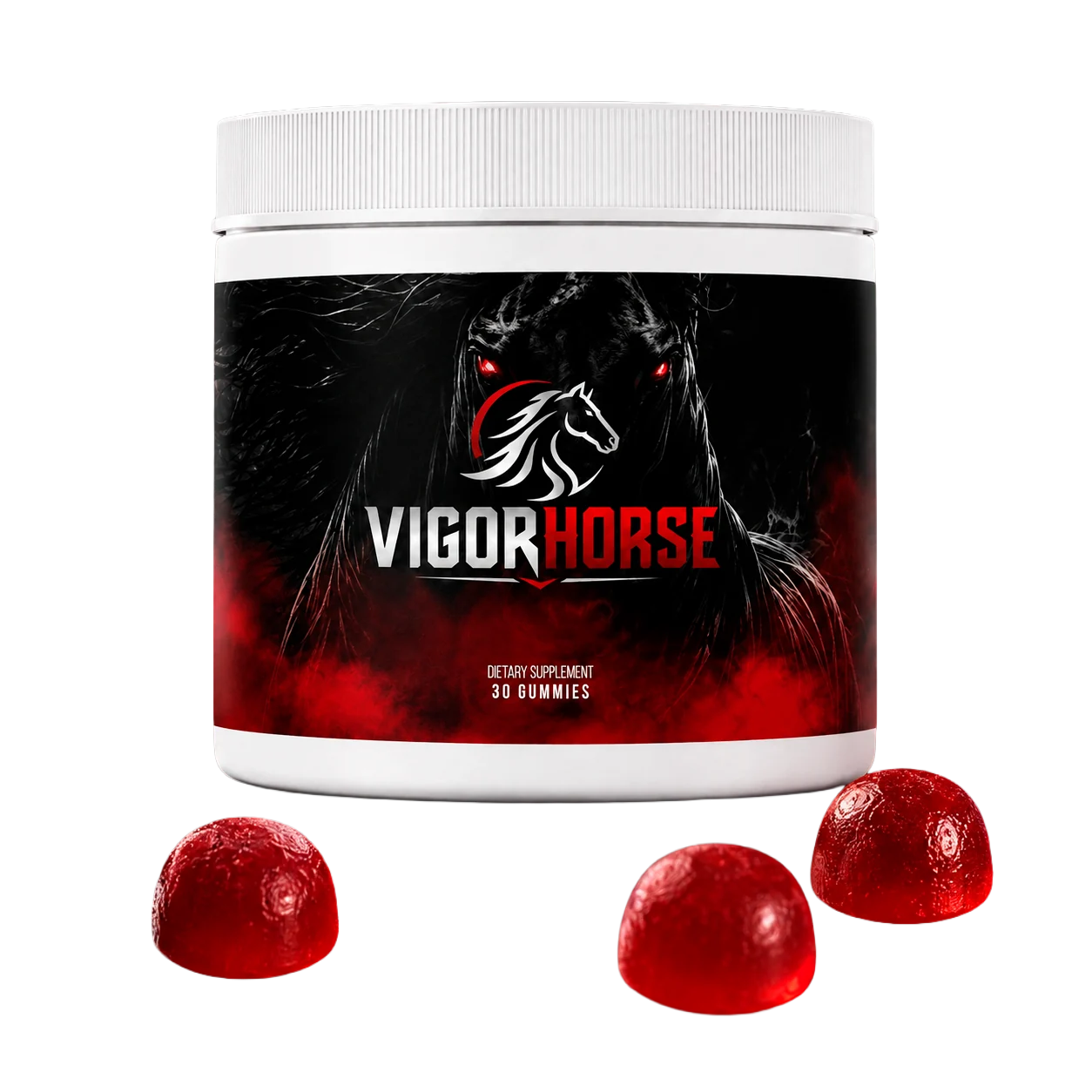
A complete printed panel, one 82 mg blend line, and a 60-day window from purchase that covers opened jars.
One jar $89 · six jars $294 · 60-day money-back guarantee
Order VigorHorse On The Official WebsiteOne gummy a day · 30 per jar · lot VIG-26/MY-7014