VigorHorse Official Website › Ingredients
IngredientsVigorHorse Ingredients
VigorHorse carries nine actives inside a single proprietary blend of 82 mg, with caffeine the only one given its own figure at 5 mg.
Muira puama, maca, catuaba, green tea, caffeine, ashwagandha, L-arginine, tribulus and horny goat weed share that line. A footnote calls the blend roughly 567 mg of dry powders.
Every name the panel prints, in the panel's own order, with the amount each one's research used beside it.
Where are the VigorHorse ingredients printed on the jar?
Four lines of type carry the whole formula, and one of them carries a number.
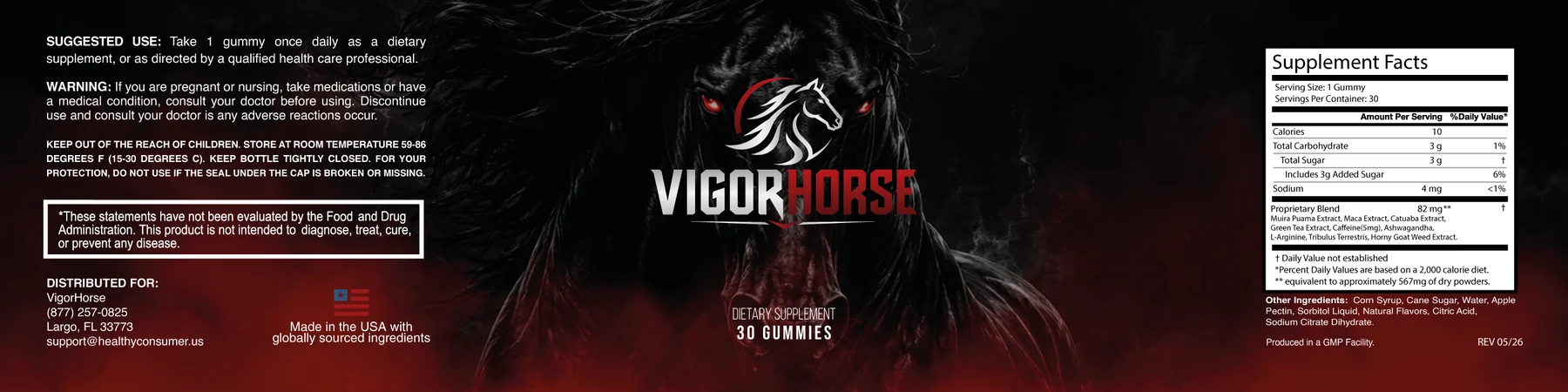
Turn the jar and the answer is four lines long. Under the nutrition rows sits one entry reading Proprietary Blend, 82 mg, and under that a paragraph of nine names in a single run of type. Caffeine is the only one with a figure attached, printed inside the name as Caffeine(5mg).
A footnote at the foot of the panel calls the 82 mg “equivalent to approximately 567mg of dry powders”, which is the manufacturer describing a concentrated extract against the raw herb it came from. Both numbers are useful and both are totals. Neither one belongs to any single name above it.
So the ingredient list on this page is the label's list, in the label's order, with one figure attached to one row. Everything else on this page is what the published research did with those nine plants and amino acids, and at what amounts.
What is in VigorHorse, ingredient by ingredient?
In panel order, each with the research behind it and the amount that research used.
Muira Puama Extract
Ptychopetalum olacoides, bark and rootIn the shared 82 mgA small Amazonian tree whose bark has been chewed and brewed in Brazil for long enough that the herbal trade calls it potency wood. The chemistry has been worked out properly: a 2018 analysis of the bark separates out sterols, coumarin and a set of fatty esters, so nobody is guessing about what the plant contains.
What has never been run is a controlled trial in people for sexual function, at any dose. A PubMed search on the species name returns plant chemistry and rodent behaviour. A pharmacology review of herbal sexual enhancers lists it among the ingredients whose reputation runs ahead of the human record, which is the honest place to leave it.
Maca Extract
Lepidium meyenii, rootIn the shared 82 mgA Peruvian root grown above 4,000 metres, dried and milled, and the one name on this blend line with a genuine randomised record for desire rather than for hormones. The 2002 trial gave healthy men 1,500 mg or 3,000 mg a day for twelve weeks and reported a rise in self-rated sexual desire from week eight, with no change in testosterone.
A later dose-finding study put the threshold plainly: 3.0 g a day moved the outcome and 1.5 g a day did not. A systematic review judged the overall evidence limited but positive in direction, and a 2009 trial used 2,400 mg a day of dry extract. Every one of those figures is in grams. The blend they are being compared against is 82 mg shared nine ways.
Catuaba Extract
Trichilia catigua and Erythroxylum species, barkIn the shared 82 mgBrazilian bark, sold under a name two unrelated botanical families answer to, which is the first thing worth knowing about it. A jar that prints Catuaba Extract and no species is not telling you which tree the powder came from, and the two have different alkaloid profiles.
The study everyone reaches for is the Catuama paper, and it did not test catuaba. It tested Catuama, a four-herb Brazilian preparation that also contains muira puama, on strips of rabbit tissue in an organ bath at 1 to 10 mg. Tissue in a bath is not a man, four herbs are not one herb, and that is the whole human-adjacent literature on this row.
Green Tea Extract
Camellia sinensis, leafIn the shared 82 mgThe concentrated leaf extract, not the brewed drink, and the reason the panel has a caffeine line at all. Its catechins are the studied fraction and they are studied at hundreds of milligrams a day, which is also the range where the US Pharmacopeia's hepatotoxicity review sets its concern about concentrated extracts taken on an empty stomach.
At the amount available inside an 82 mg blend, neither the benefit literature nor the liver-safety literature is really describing this gummy. The earlier USP safety review reached the same split: the brewed beverage sits in one risk bracket and high-dose concentrated extract sits in another. A fraction of 82 mg is below both brackets.
Caffeine
broken out on the panel at 5 mg5 mg, printedThe one row on this jar that carries its own number, and the only ingredient here whose amount a reader never has to estimate. Five milligrams a gummy. A small cup of coffee runs 80 to 100 mg, a can of cola around 34 mg, and a square of dark chocolate lands near this one.
The health review that set the familiar ceiling treats 400 mg a day as unremarkable for healthy adults, and a 2017 systematic review confirmed the same figure while setting 300 mg a day in pregnancy. Five milligrams is one eightieth of that ceiling. It is worth adding to a daily tally if you keep one, and it is not a stimulant dose.
Ashwagandha
Withania somnifera, rootIn the shared 82 mgAn Ayurvedic root with the largest modern trial file of anything on this line. The 2019 vitality crossover used an extract delivering 21 mg a day of withanolide glycosides and reported improved self-rated vitality in men; the fertility pilot used 675 mg a day of root extract in three divided doses across ninety days.
It is also the row that needs its safety file read rather than skipped. A case series from Iceland and the US DILI Network and a second series from India both document liver injury linked to ashwagandha products at ordinary supplement doses. And a 2026 hormone meta-analysis found no change in TSH or T3, so nothing here supports a thyroid or testosterone story.
L-Arginine
a free amino acidIn the shared 82 mgNot a herb. An amino acid the body converts into nitric oxide, which relaxes the smooth muscle in blood-vessel walls, and the most mechanically explainable name on the jar. The mechanism is textbook. The question is only ever how much.
The trial that worked used 5,000 mg a day for six weeks. The crossover at 1,500 mg a day performed no better than placebo. The pooled meta-analysis spans 1,500 to 5,000 mg a day, and the blood-pressure dose-response work needed 4,000 mg a day and upwards before pressure moved. A daily chicken breast carries more arginine than the whole blend weighs.
Tribulus Terrestris
puncture vine, aerial parts and fruitIn the shared 82 mgThe row with the loudest reputation and the least supportive trial record, which is an unusual combination worth stating rather than smoothing over. An 800 mg a day trial over thirty days and a 450 mg a day trial over five weeks both came back negative on their primary outcomes.
The androgen study in young men gave 10 to 20 mg per kilogram of body weight a day and measured no change in testosterone, androstenedione or luteinising hormone. A 2017 trial of a standardised Bulgarian tablet is the one positive signal, and a 2026 meta-analysis reads the pooled picture as weak. This desk does not call it a testosterone ingredient, because the measurements do not.
Horny Goat Weed Extract
Epimedium species, leafIn the shared 82 mgThe seller's own pack writes this one as Horny Goat Weed (Icariin). The bottle does not. The panel prints Horny Goat Weed Extract with no standardisation figure beside it, so nothing on the jar states how much icariin, if any, a gummy carries. Where the two disagree the bottle is what arrived in the box, and the bottle wins.
The interesting chemistry is real and it is also in vitro. The enzyme study reports icariin inhibiting human PDE5 at an IC50 of 5.9 micromolar in a test tube, with synthetic derivatives far more potent than the natural compound. The animal work used 10 mg per kilogram in rats. Neither is a human outcome, and neither belongs in a sentence beside a prescription drug.
Which VigorHorse ingredients have human trials behind them?
Three tiers, because the nine names do not carry equal research behind them.
| Evidence tier | Names on this panel | What exists |
|---|---|---|
| Randomised human trials exist | Maca, L-arginine, ashwagandha, tribulus, caffeine | Placebo-controlled trials with stated daily amounts and measured outcomes. Results run from positive at gram doses down to flatly negative. |
| Laboratory and animal work only | Horny goat weed, green tea extract at extract strength | Enzyme assays, isolated tissue and rodents. Real findings about the compound, with no human outcome study behind them. |
| No controlled human trial at any dose | Muira puama, catuaba | Plant chemistry, traditional use and, for catuaba, one organ-bath study of a four-herb blend that is not this ingredient alone. |
Tiers describe the published literature on each plant, not this gummy, and they follow how the urology ingredient guide and the 2020 aphrodisiac review sort the same category. No trial listed here tested VigorHorse.
How much of each active does a VigorHorse gummy carry?
One printed total, two ways to divide it, and the trial amounts beside each name.
One gummy carries 82 mg of blend. Divide that evenly across nine names and each gets roughly 9 mg. Take the label's own footnote instead, treat the blend as 567 mg of dry powder equivalent, and divide that nine ways for about 63 mg a name. Both figures are arithmetic on the label's own numbers, and the real split is almost certainly uneven, since blends are normally weighted towards their cheapest bulk ingredient.
Either way, the comparison below is the same. The right-hand column is what the trials used.
Caffeine is the exception in both directions: it is the only row with a printed amount, and it is the only row where the printed amount is far below the level any safety review worries about. Everywhere else the gap runs the other way.
This is the section where that gap gets stated. It is not restated on the other pages of this site, because a fact repeated in every section stops being information and starts being an argument.
What else is inside a VigorHorse gummy?
Eight inactive entries, three of which are sugar, and one that answers the gelatin question.
Eight entries sit under Other Ingredients: corn syrup, cane sugar, water, apple pectin, sorbitol liquid, natural flavors, citric acid and sodium citrate dihydrate. Corn syrup and cane sugar lead that line, which is the honest reason a gummy tastes like a sweet, and the nutrition rows above confirm it: 10 calories, 3 g of total sugar and 3 g of added sugar at 6% of the daily value.
- Apple pectin sets the gummy. It is a fruit gelling agent, which is what makes this a pectin gummy rather than a gelatin one, so the base is not animal-derived.
- Sorbitol liquid holds moisture and adds sweetness. In quantity it is a known cause of loose stools, though a single gummy carries very little.
- Citric acid and sodium citrate dihydrate set the acidity and the tartness, and the sodium citrate is where the panel's 4 mg of sodium comes from.
- Natural flavors is a regulated collective term rather than one substance. It covers flavouring derived from plant or animal sources without naming them.
Produced in a GMP Facility. Made in the USA with globally sourced ingredients. Both lines are printed on the jar, and what each one does and does not certify is set out on the testing and quality page rather than repeated here.
One practical note for anyone comparing jars: gummy manufacturing has a measurement problem that capsules do not. A 2023 JAMA analysis of melatonin gummies found products whose measured content ranged from a fraction of the label figure to more than triple it. That study tested a different category, and it is the reason a third-party certificate matters more on a gummy than on a tablet.
VigorHorse ingredient questions
Does VigorHorse list how much maca or L-arginine is in each gummy?
Is the horny goat weed in VigorHorse standardised to icariin?
Are all nine VigorHorse ingredients plants?
Does VigorHorse contain gelatin?
Is there caffeine in every VigorHorse gummy?
Does VigorHorse raise testosterone?
Sources behind the VigorHorse ingredient list
Grouped in the order the blend line prints the name each one belongs to, category reviews first.
- Cui T, Kovell RC, Brooks DC, et al. A Urologist's Guide to Ingredients Found in Top-Selling Nutraceuticals for Men's Sexual Health. J Sex Med. 2015;12(11):2105-17. PMID 26531010. https://pubmed.ncbi.nlm.nih.gov/26531010/
- Srivatsav A, Balasubramanian A, Pathak UI, et al. Efficacy and Safety of Common Ingredients in Aphrodisiacs Used for Erectile Dysfunction: A Review. Sex Med Rev. 2020;8(3):431-442. PMID 32139335. https://pubmed.ncbi.nlm.nih.gov/32139335/
- Tian X, Guo S, He K, et al. Qualitative and quantitative analysis of chemical constituents of Ptychopetalum olacoides Benth. Nat Prod Res. 2018;32(3):354-357. PMID 28750557. https://pubmed.ncbi.nlm.nih.gov/28750557/
- Brunetti P, Lo Faro AF, Tini A, et al. Pharmacology of Herbal Sexual Enhancers: A Review of Psychiatric and Neurological Adverse Effects. Pharmaceuticals (Basel). 2020;13(10). PMID 33066617. https://pubmed.ncbi.nlm.nih.gov/33066617/
- Gonzales GF, Córdova A, Vega K, et al. Effect of Lepidium meyenii (MACA) on sexual desire and its absent relationship with serum testosterone levels in adult healthy men. Andrologia. 2002;34(6):367-72. PMID 12472620. https://pubmed.ncbi.nlm.nih.gov/12472620/
- Zenico T, Cicero AF, Valmorri L, et al. Subjective effects of Lepidium meyenii (Maca) extract on well-being and sexual performances in patients with mild erectile dysfunction: a randomised, double-blind clinical trial. Andrologia. 2009;41(2):95-9. PMID 19260845. https://pubmed.ncbi.nlm.nih.gov/19260845/
- Shin BC, Lee MS, Yang EJ, et al. Maca (L. meyenii) for improving sexual function: a systematic review. BMC Complement Altern Med. 2010;10:44. PMID 20691074. https://pubmed.ncbi.nlm.nih.gov/20691074/
- Dording CM, Fisher L, Papakostas G, et al. A double-blind, randomized, pilot dose-finding study of maca root (L. meyenii) for the management of SSRI-induced sexual dysfunction. CNS Neurosci Ther. 2008;14(3):182-91. PMID 18801111. https://pubmed.ncbi.nlm.nih.gov/18801111/
- Antunes E, Gordo WM, de Oliveira JF, et al. The relaxation of isolated rabbit corpus cavernosum by the herbal medicine Catuama and its constituents. Phytother Res. 2001;15(5):416-21. PMID 11507734. https://pubmed.ncbi.nlm.nih.gov/11507734/
- Oketch-Rabah HA, Roe AL, Rider CV, et al. United States Pharmacopeia (USP) comprehensive review of the hepatotoxicity of green tea extracts. Toxicol Rep. 2020;7:386-402. PMID 32140423. https://pubmed.ncbi.nlm.nih.gov/32140423/
- Sarma DN, Barrett ML, Chavez ML, et al. Safety of green tea extracts: a systematic review by the US Pharmacopeia. Drug Saf. 2008;31(6):469-84. PMID 18484782. https://pubmed.ncbi.nlm.nih.gov/18484782/
- Nawrot P, Jordan S, Eastwood J, et al. Effects of caffeine on human health. Food Addit Contam. 2003;20(1):1-30. PMID 12519715. https://pubmed.ncbi.nlm.nih.gov/12519715/
- Wikoff D, Welsh BT, Henderson R, et al. Systematic review of the potential adverse effects of caffeine consumption in healthy adults, pregnant women, adolescents, and children. Food Chem Toxicol. 2017;109(Pt 1):585-648. PMID 28438661. https://pubmed.ncbi.nlm.nih.gov/28438661/
- Lopresti AL, Drummond PD, Smith SJ. A Randomized, Double-Blind, Placebo-Controlled, Crossover Study Examining the Hormonal and Vitality Effects of Ashwagandha (Withania somnifera) in Aging, Overweight Males. Am J Mens Health. 2019;13(2):1557988319835985. PMID 30854916. https://pubmed.ncbi.nlm.nih.gov/30854916/
- Ambiye VR, Langade D, Dongre S, et al. Clinical Evaluation of the Spermatogenic Activity of the Root Extract of Ashwagandha (Withania somnifera) in Oligospermic Males: A Pilot Study. Evid Based Complement Alternat Med. 2013;2013:571420. PMID 24371462. https://pubmed.ncbi.nlm.nih.gov/24371462/
- Fornalik M, Malkiewicz A, Adamczak D, et al. Hormonal Modulation with Withania somnifera: Systematic Review and Meta-Analysis of Randomized-controlled Trials. Planta Med. 2026;92(8):790-805. PMID 41740946. https://pubmed.ncbi.nlm.nih.gov/41740946/
- Björnsson HK, Björnsson ES, Avula B, et al. Ashwagandha-induced liver injury: A case series from Iceland and the US Drug-Induced Liver Injury Network. Liver Int. 2020;40(4):825-829. PMID 31991029. https://pubmed.ncbi.nlm.nih.gov/31991029/
- Philips CA, Valsan A, Theruvath AH, et al. Ashwagandha-induced liver injury-A case series from India and literature review. Hepatol Commun. 2023;7(10). PMID 37756041. https://pubmed.ncbi.nlm.nih.gov/37756041/
- Chen J, Wollman Y, Chernichovsky T, et al. Effect of oral administration of high-dose nitric oxide donor L-arginine in men with organic erectile dysfunction: results of a double-blind, randomized, placebo-controlled study. BJU Int. 1999;83(3):269-73. PMID 10233492. https://pubmed.ncbi.nlm.nih.gov/10233492/
- Klotz T, Mathers MJ, Braun M, et al. Effectiveness of oral L-arginine in first-line treatment of erectile dysfunction in a controlled crossover study. Urol Int. 1999;63(4):220-3. PMID 10743698. https://pubmed.ncbi.nlm.nih.gov/10743698/
- Rhim HC, Kim MS, Park YJ, et al. The Potential Role of Arginine Supplements on Erectile Dysfunction: A Systemic Review and Meta-Analysis. J Sex Med. 2019;16(2):223-234. PMID 30770070. https://pubmed.ncbi.nlm.nih.gov/30770070/
- Shiraseb F, Asbaghi O, Bagheri R, et al. Effect of l-Arginine Supplementation on Blood Pressure in Adults: A Systematic Review and Dose-Response Meta-analysis of Randomized Clinical Trials. Adv Nutr. 2022;13(4):1226-1242. PMID 34967840. https://pubmed.ncbi.nlm.nih.gov/34967840/
- Santos CA Jr, Reis LO, Destro-Saade R, et al. Tribulus terrestris versus placebo in the treatment of erectile dysfunction: A prospective, randomized, double blind study. Actas Urol Esp. 2014;38(4):244-8. PMID 24630840. https://pubmed.ncbi.nlm.nih.gov/24630840/
- Neychev VK, Mitev VI. The aphrodisiac herb Tribulus terrestris does not influence the androgen production in young men. J Ethnopharmacol. 2005;101(1-3):319-23. PMID 15994038. https://pubmed.ncbi.nlm.nih.gov/15994038/
- Suharyani S, Amanda B, Angellee J, et al. Tribulus terrestris for management of patients with erectile dysfunction: a systematic review and meta-analysis of randomized trials. Int J Impot Res. 2026;38(1):11-18. PMID 40360723. https://pubmed.ncbi.nlm.nih.gov/40360723/
- Rogerson S, Riches CJ, Jennings C, et al. The effect of five weeks of Tribulus terrestris supplementation on muscle strength and body composition during preseason training in elite rugby league players. J Strength Cond Res. 2007;21(2):348-53. PMID 17530942. https://pubmed.ncbi.nlm.nih.gov/17530942/
- Kamenov Z, Fileva S, Kalinov K, et al. Evaluation of the efficacy and safety of Tribulus terrestris in male sexual dysfunction-A prospective, randomized, double-blind, placebo-controlled clinical trial. Maturitas. 2017;99:20-26. PMID 28364864. https://pubmed.ncbi.nlm.nih.gov/28364864/
- Dell'Agli M, Galli GV, Dal Cero E, et al. Potent inhibition of human phosphodiesterase-5 by icariin derivatives. J Nat Prod. 2008;71(9):1513-7. PMID 18778098. https://pubmed.ncbi.nlm.nih.gov/18778098/
- Shindel AW, Xin ZC, Lin G, et al. Erectogenic and neurotrophic effects of icariin, a purified extract of horny goat weed (Epimedium spp.) in vitro and in vivo. J Sex Med. 2010;7(4 Pt 1):1518-28. PMID 20141584. https://pubmed.ncbi.nlm.nih.gov/20141584/
- Cohen PA, Avula B, Wang YH, et al. Quantity of Melatonin and CBD in Melatonin Gummies Sold in the US. JAMA. 2023;329(16):1401-1402. PMID 37097362. https://pubmed.ncbi.nlm.nih.gov/37097362/
Order VigorHorse with the whole ingredient list in front of you
Nine actives, one 82 mg blend line, 30 gummies a jar and 60 days from purchase to change your mind.
One jar $89 · six jars $294 · 60-day money-back guarantee
Order VigorHorse On The Official WebsiteOne gummy a day · 30 per jar · lot VIG-26/MY-7014