VigorHorse Official Website › Category guide
Category guideMale Vitality Supplement Guide
Male vitality supplements draw on a narrow pool of eight or nine botanicals, and what differs between them is amount, transparency and what the seller claims.
This guide covers how to judge a claim in this category rather than listing the plants: the evidence tiers, the dose thresholds and the arithmetic.
A guide to the method behind the claims, written about the shelf rather than about any one jar.
What this shelf is actually selling
A narrow ingredient pool, repeated across a wide shelf, and the three things that actually differ.
Walk the male vitality section of any supplement retailer and the same eight or nine botanical names recur across dozens of products. Maca, tribulus, horny goat weed, ashwagandha, L-arginine, muira puama, catuaba, ginseng, green tea. The formulas differ in packaging far more than in composition.
That is not a conspiracy. It is what happens when a category has a small number of ingredients with any published human record at all, and every manufacturer reads the same reviews. An analysis of the products actually on sale found exactly that pattern: a narrow ingredient pool, heavily repeated, at amounts that rarely match the trials.
What differs between two jars on that shelf is therefore not usually which plants are in them. It is three other things: how much of each, whether you are told how much, and what the seller is willing to claim.
Those three are what this guide is about. It does not walk the ingredients one at a time, because that list is available anywhere. It covers how to judge a claim about any of them.
Three tiers of evidence, and how to tell them apart
Three kinds of study, and the sentence that gives away which one a claim came from.
Almost every claim in this category rests on one of three kinds of study, and they are not interchangeable. Knowing which tier a claim comes from settles most arguments before they start.
| Tier | What it is | What it can support | Where it appears in this category |
|---|---|---|---|
| Randomised controlled trials in people | A stated dose, a placebo group, a measured outcome, a stated duration | That the ingredient at that dose changed that outcome in that population | Maca, L-arginine, ashwagandha, tribulus, caffeine |
| Animal work | A dose per kilogram of body weight, in a species that is not human | That a mechanism is plausible enough to test in people | Icariin from horny goat weed, several of the barks |
| Laboratory work | Enzymes, cell culture or isolated tissue in a bath | That a compound does something chemically. Nothing about a person | The icariin enzyme assay, the catuaba organ-bath study |
Every tier produces real findings. The error is attaching a tier-three result to a tier-one sentence.
The move to watch for is a sales page that describes a laboratory result in the language of a clinical one. The icariin enzyme study is a genuine piece of chemistry: icariin inhibits human PDE5 at an IC50 of 5.9 micromolar in a test tube, and the compounds that come close to a prescription drug's potency are synthetic derivatives chemists built.
The follow-up work used 10 mg per kilogram in rats. Neither is a human outcome, and a sentence that puts either beside a prescription tablet has crossed two tiers in one breath.
The same test applies in the other direction. The one relaxation study everyone cites for catuaba tested Catuama, a four-herb Brazilian preparation, on strips of rabbit tissue at 1 to 10 mg. Tissue in a bath is not a man and four herbs are not one herb.
Why a threshold dose behaves differently from a gradient
Two ingredients where a lower dose produced nothing rather than less.
Most people read a dose as a dial: more does more, less does less, and half a dose does half as much. In this category that intuition is wrong more often than it is right, because several of the best-studied ingredients behave as thresholds instead.
L-arginine is the clean worked example. The trial that produced a result used 5,000 mg a day for six weeks. A crossover at 1,500 mg a day performed no better than placebo. The pooled meta-analysis spans that whole range, and the blood-pressure dose-response work needed 4,000 mg a day and upwards before pressure moved at all.
So 1,500 mg is not three tenths of an effect. On the published evidence it is no effect. That is what a threshold means, and it is why a product carrying a tenth of the lower figure cannot be described as carrying a tenth of the benefit.
Maca shows the same shape from a different direction. The dose-finding study compared 3.0 g a day against 1.5 g a day and found the higher dose moved its outcome while the lower one did not. Same plant, same trial, same measurement, twofold difference in dose, and one arm worked.
Once you have seen that twice, the arithmetic on a label stops being pedantry. A figure below a published threshold is not a smaller version of the trial; it is outside what the trial tested.
- What amount did the positive trial use? Not the range across all trials, the amount in the one that reported a result.
- Was a lower amount tested, and what happened? A negative low-dose arm is the most informative single fact in this whole category.
- Is the product's figure above or below that line? Below it, the trial is not evidence about the product. It is evidence about a different amount.
The unit problem, which is where most of the gap lives
Six trial doses, and the unit each one is measured in.
Read across this category with a calculator and one pattern dominates everything else. The trials that worked are measured in grams. The labels are measured in milligrams, and often in tens of milligrams.
| Ingredient | The amount its research used | The unit |
|---|---|---|
| L-arginine | 5,000 mg a day in the positive trial; 1,500 mg a day was negative | Grams |
| Maca | 1,500 to 3,000 mg a day across every trial | Grams |
| Ashwagandha, fertility | 675 mg a day of root extract in three divided doses | Hundreds of milligrams |
| Ashwagandha, vitality | An extract delivering 21 mg a day of withanolide glycosides | Tens of milligrams, of a standardised fraction |
| Tribulus | 800 mg a day and 450 mg a day, both negative | Hundreds of milligrams |
| Caffeine | 400 mg a day treated as unremarkable for healthy adults | Hundreds of milligrams |
Doses as the abstracts state them. The ashwagandha rows differ because the two trials measured different things in different units.
Set a typical multi-ingredient blend beside that table and the mismatch is usually an order of magnitude or two, not a near miss. A blend total in the tens of milligrams shared across eight or nine names cannot reach a gram-level figure for any of them, and no amount of extract-ratio footnoting changes the arithmetic.
The ashwagandha rows are the exception worth understanding, because they show the one honest route to a small number. The vitality crossover used an extract standardised to deliver 21 mg a day of withanolide glycosides. A small figure of a standardised active fraction is a real dose. A small figure of unstandardised whole-herb extract is not the same thing, and a label that prints no standardisation is not claiming it.
The hormone story, and why it keeps failing measurement
Three ingredients, three measurements, and the one positive result that is not hormonal.
A large part of this shelf is sold on an implied hormonal mechanism. Three separate results, from three different ingredients, point the other way, and they are worth knowing because they are measurements rather than opinions.
- Tribulus. The androgen study in young men gave 10 to 20 mg per kilogram of body weight a day and measured no change in testosterone, androstenedione or luteinising hormone. An 800 mg a day trial and a 450 mg a day trial were both negative on their primary outcomes.
- Maca. The hormone arm of the maca work gave 1,500 or 3,000 mg a day and found no reproductive hormone changed. The desire result in the 2002 trial happened anyway, explicitly without a hormonal explanation.
- Ashwagandha. The 2026 hormone meta-analysis pooled the randomised evidence and found no change in TSH or T3.
The maca result is the interesting one, because it is positive and it is not hormonal. Self-rated desire rose from week eight while measured hormones did not move, which is a real finding and a reminder that a mechanism nobody can name is not the same as an effect nobody measured.
The practical upshot is narrow and useful. A product claiming to raise testosterone is claiming something these three measurements did not find, and a product claiming to support desire has at least one trial behind the idea at a gram-level dose.
A 2022 scoping review of botanicals and the testis reaches the same place from a wider angle: a large literature, a small number of controlled human outcomes, and a persistent gap between what is sold and what has been measured.
What a proprietary blend can and cannot tell you
Two columns, and one free inference most readers never make.
A proprietary blend is a labelling format written into United States regulation rather than a way of hiding something. Its members are listed in descending order of predominance by weight, and the blend carries a single total.
| The format settles | The format leaves open |
|---|---|
| The rank order of every name in the blend | The interval between one rank and the next |
| A ceiling: nothing exceeds the blend total | A floor: any name could be a trace |
| Where a broken-out ingredient sits, if one is printed | Everything above and below it, in amount |
| That the manufacturer knows the split | Whether the split resembles any trial protocol |
Descending order of predominance is the rule. Read with it, a blend line carries more information than most readers expect and less than a full panel.
There is one trick worth knowing, and it is free. If a blend breaks out a single ingredient with a printed figure, every name listed after it weighs no more than that figure. One printed number fixes a ceiling for the whole tail of the list.
That is often the single most informative thing on a blend label, and almost nobody uses it.
What the format cannot do is let anybody compare a product against a published protocol. A trial used a stated amount of one thing, and a blend states a total for several. The two are not commensurable, and a page that implies otherwise is borrowing a trial's credibility for a number it never tested.
Where the real safety questions in this category sit
Two liver literatures, one easy ingredient, and three specific pairings.
Not, mostly, with the botanicals at the amounts typically sold. Two specific literatures are worth reading and both concern concentrated extracts at hundreds of milligrams a day.
Ashwagandha and the liver
A case series from Iceland and the US drug-induced liver injury network and a second series from India document liver injury associated with ashwagandha products at ordinary supplement doses. The reported cases involved standalone extracts, and the picture in both was reversible on stopping.
Green tea extract and the liver
The US Pharmacopeia hepatotoxicity review and its earlier safety review separate the brewed drink from concentrated extract and put the concern on high-dose extract, particularly on an empty stomach. The catechin amounts at issue run to hundreds of milligrams.
Caffeine, which is the easy one
The review that set the familiar ceiling treats 400 mg a day as unremarkable for healthy adults and a 2017 systematic review confirms it, setting 300 mg a day in pregnancy. It is the one ingredient in this category whose amount is almost always printed.
Interactions, which are specific rather than general
Arginine and nitrates share a pathway. Several botanicals are discussed in connection with platelet behaviour. Ashwagandha and sedation are additive. Naming three specific pairings is worth more than a paragraph of general caution repeated on every page.
The honest summary is that this category's safety profile is dominated by dose and by what else somebody is taking, rather than by the plants themselves. A blend carrying tens of milligrams shared across nine names sits far below every amount in either liver literature.
Which is not the same as saying a small dose is automatically safe for everybody. Anyone who has had a supplement-related liver problem before has the best available predictor of the next one.
Why every product on this shelf says the same four words
Four words, one regulation, and why they appear on everything.
Supports circulation. Supports libido. Supports stamina. Supports male vitality. The phrasing recurs because a dietary supplement in the United States may make structure-function claims and may not make disease claims, and those four are the category's version of the permitted form.
A structure-function claim says a product supports the normal function of a part of the body. A disease claim says it treats, prevents or cures a condition. The first is allowed with a disclaimer; the second turns the product into an unapproved drug.
That is why the whole shelf reads the same. It is not marketers running out of ideas, it is a ceiling everybody is writing up to.
- Supports is the word doing the legal work in all four phrases.
- The disclaimer is required alongside them: these statements have not been evaluated by the Food and Drug Administration, and the product is not intended to diagnose, treat, cure or prevent any disease.
- No supplement in this category is FDA-approved, because supplements are not approved before sale. A facility registration is a filing.
- A page that names a condition has stepped over the line, whatever the small print underneath says.
Reading the four words as the ceiling rather than as the pitch is the single most useful adjustment a buyer can make in this aisle. They describe what a seller is permitted to say, not what the product has been shown to do.
The whole guide, on one screen
Eight things, and then the one product this website sells, measured against them.
- The ingredient pool is narrow and heavily repeated. What differs between jars is amount, transparency and what the seller claims.
- Check which tier a claim comes from. A test tube, a rat and a person are three different kinds of evidence, and the language often hides which one is in use.
- Several key ingredients behave as thresholds. Below the line the published result is nothing, not less.
- The trials are in grams and the labels are in milligrams. That gap is the central fact of this category and it is arithmetic anybody can do.
- The hormone story has been measured and did not appear. Three ingredients, three null results.
- A blend line gives you rank, a ceiling and one free inference, and cannot give you a comparison against a protocol.
- The safety questions are about dose and about what else you take, and the two liver literatures concern amounts far above a shared blend total.
- The four words on every box are a legal ceiling, not a summary of findings.
Applied to the jar this website sells: VigorHorse prints a complete panel, which a good part of this shelf does not, and it prints one amount, 82 mg, for 9 actives with caffeine broken out at 5 mg. The rank order is therefore readable and the per-name amounts are not, and every active except caffeine sits far below the gram-level doses above.
The full arithmetic is on the ingredients page, where it belongs. This guide exists so that page can be read critically rather than taken on trust.
Who publishes this VigorHorse guide, and what it cites
Every study named above, in house order, category reviews first.
- Cui T, Kovell RC, Brooks DC, et al. A Urologist's Guide to Ingredients Found in Top-Selling Nutraceuticals for Men's Sexual Health. J Sex Med. 2015;12(11):2105-17. PMID 26531010. https://pubmed.ncbi.nlm.nih.gov/26531010/
- Srivatsav A, Balasubramanian A, Pathak UI, et al. Efficacy and Safety of Common Ingredients in Aphrodisiacs Used for Erectile Dysfunction: A Review. Sex Med Rev. 2020;8(3):431-442. PMID 32139335. https://pubmed.ncbi.nlm.nih.gov/32139335/
- Petre GC, Francini-Pesenti F, Vitagliano A, et al. Dietary Supplements for Erectile Dysfunction: Analysis of Marketed Products, Systematic Review, Meta-Analysis and Rational Use. Nutrients. 2023;15(17). PMID 37686709. https://pubmed.ncbi.nlm.nih.gov/37686709/
- Borrelli F, Colalto C, Delfino DV, et al. Herbal Dietary Supplements for Erectile Dysfunction: A Systematic Review and Meta-Analysis. Drugs. 2018;78(6):643-673. PMID 29633089. https://pubmed.ncbi.nlm.nih.gov/29633089/
- Barbonetti A, Tienforti D, Antolini F, et al. Nutraceutical interventions for erectile dysfunction: a systematic review and network meta-analysis. J Sex Med. 2024;21(11):1054-1063. PMID 39279185. https://pubmed.ncbi.nlm.nih.gov/39279185/
- Leisegang K, Finelli R. Alternative medicine and herbal remedies in the treatment of erectile dysfunction: A systematic review. Arab J Urol. 2021;19(3):323-339. PMID 34552783. https://pubmed.ncbi.nlm.nih.gov/34552783/
- Ho CY, Hsu CH, Chien TJ. Herbal dietary supplements for erectile dysfunction: A systematic review and meta-analysis of randomized-controlled trials. J Tradit Complement Med. 2026;16(1):109-120. PMID 41696741. https://pubmed.ncbi.nlm.nih.gov/41696741/
- Gonzales GF, Córdova A, Vega K, et al. Effect of Lepidium meyenii (MACA) on sexual desire and its absent relationship with serum testosterone levels in adult healthy men. Andrologia. 2002;34(6):367-72. PMID 12472620. https://pubmed.ncbi.nlm.nih.gov/12472620/
- Gonzales GF, Córdova A, Vega K, et al. Effect of Lepidium meyenii (Maca), a root with aphrodisiac and fertility-enhancing properties, on serum reproductive hormone levels in adult healthy men. J Endocrinol. 2003;176(1):163-8. PMID 12525260. https://pubmed.ncbi.nlm.nih.gov/12525260/
- Dording CM, Fisher L, Papakostas G, et al. A double-blind, randomized, pilot dose-finding study of maca root (L. meyenii) for the management of SSRI-induced sexual dysfunction. CNS Neurosci Ther. 2008;14(3):182-91. PMID 18801111. https://pubmed.ncbi.nlm.nih.gov/18801111/
- Shin BC, Lee MS, Yang EJ, et al. Maca (L. meyenii) for improving sexual function: a systematic review. BMC Complement Altern Med. 2010;10:44. PMID 20691074. https://pubmed.ncbi.nlm.nih.gov/20691074/
- Antunes E, Gordo WM, de Oliveira JF, et al. The relaxation of isolated rabbit corpus cavernosum by the herbal medicine Catuama and its constituents. Phytother Res. 2001;15(5):416-21. PMID 11507734. https://pubmed.ncbi.nlm.nih.gov/11507734/
- Oketch-Rabah HA, Roe AL, Rider CV, et al. United States Pharmacopeia (USP) comprehensive review of the hepatotoxicity of green tea extracts. Toxicol Rep. 2020;7:386-402. PMID 32140423. https://pubmed.ncbi.nlm.nih.gov/32140423/
- Sarma DN, Barrett ML, Chavez ML, et al. Safety of green tea extracts: a systematic review by the US Pharmacopeia. Drug Saf. 2008;31(6):469-84. PMID 18484782. https://pubmed.ncbi.nlm.nih.gov/18484782/
- Nawrot P, Jordan S, Eastwood J, et al. Effects of caffeine on human health. Food Addit Contam. 2003;20(1):1-30. PMID 12519715. https://pubmed.ncbi.nlm.nih.gov/12519715/
- Wikoff D, Welsh BT, Henderson R, et al. Systematic review of the potential adverse effects of caffeine consumption in healthy adults, pregnant women, adolescents, and children. Food Chem Toxicol. 2017;109(Pt 1):585-648. PMID 28438661. https://pubmed.ncbi.nlm.nih.gov/28438661/
- Lopresti AL, Drummond PD, Smith SJ. A Randomized, Double-Blind, Placebo-Controlled, Crossover Study Examining the Hormonal and Vitality Effects of Ashwagandha (Withania somnifera) in Aging, Overweight Males. Am J Mens Health. 2019;13(2):1557988319835985. PMID 30854916. https://pubmed.ncbi.nlm.nih.gov/30854916/
- Fornalik M, Malkiewicz A, Adamczak D, et al. Hormonal Modulation with Withania somnifera: Systematic Review and Meta-Analysis of Randomized-controlled Trials. Planta Med. 2026;92(8):790-805. PMID 41740946. https://pubmed.ncbi.nlm.nih.gov/41740946/
- Björnsson HK, Björnsson ES, Avula B, et al. Ashwagandha-induced liver injury: A case series from Iceland and the US Drug-Induced Liver Injury Network. Liver Int. 2020;40(4):825-829. PMID 31991029. https://pubmed.ncbi.nlm.nih.gov/31991029/
- Philips CA, Valsan A, Theruvath AH, et al. Ashwagandha-induced liver injury-A case series from India and literature review. Hepatol Commun. 2023;7(10). PMID 37756041. https://pubmed.ncbi.nlm.nih.gov/37756041/
- Chen J, Wollman Y, Chernichovsky T, et al. Effect of oral administration of high-dose nitric oxide donor L-arginine in men with organic erectile dysfunction: results of a double-blind, randomized, placebo-controlled study. BJU Int. 1999;83(3):269-73. PMID 10233492. https://pubmed.ncbi.nlm.nih.gov/10233492/
- Klotz T, Mathers MJ, Braun M, et al. Effectiveness of oral L-arginine in first-line treatment of erectile dysfunction in a controlled crossover study. Urol Int. 1999;63(4):220-3. PMID 10743698. https://pubmed.ncbi.nlm.nih.gov/10743698/
- Rhim HC, Kim MS, Park YJ, et al. The Potential Role of Arginine Supplements on Erectile Dysfunction: A Systemic Review and Meta-Analysis. J Sex Med. 2019;16(2):223-234. PMID 30770070. https://pubmed.ncbi.nlm.nih.gov/30770070/
- Shiraseb F, Asbaghi O, Bagheri R, et al. Effect of l-Arginine Supplementation on Blood Pressure in Adults: A Systematic Review and Dose-Response Meta-analysis of Randomized Clinical Trials. Adv Nutr. 2022;13(4):1226-1242. PMID 34967840. https://pubmed.ncbi.nlm.nih.gov/34967840/
- Santos CA Jr, Reis LO, Destro-Saade R, et al. Tribulus terrestris versus placebo in the treatment of erectile dysfunction: A prospective, randomized, double blind study. Actas Urol Esp. 2014;38(4):244-8. PMID 24630840. https://pubmed.ncbi.nlm.nih.gov/24630840/
- Neychev VK, Mitev VI. The aphrodisiac herb Tribulus terrestris does not influence the androgen production in young men. J Ethnopharmacol. 2005;101(1-3):319-23. PMID 15994038. https://pubmed.ncbi.nlm.nih.gov/15994038/
- Rogerson S, Riches CJ, Jennings C, et al. The effect of five weeks of Tribulus terrestris supplementation on muscle strength and body composition during preseason training in elite rugby league players. J Strength Cond Res. 2007;21(2):348-53. PMID 17530942. https://pubmed.ncbi.nlm.nih.gov/17530942/
- Suharyani S, Amanda B, Angellee J, et al. Tribulus terrestris for management of patients with erectile dysfunction: a systematic review and meta-analysis of randomized trials. Int J Impot Res. 2026;38(1):11-18. PMID 40360723. https://pubmed.ncbi.nlm.nih.gov/40360723/
- Dell'Agli M, Galli GV, Dal Cero E, et al. Potent inhibition of human phosphodiesterase-5 by icariin derivatives. J Nat Prod. 2008;71(9):1513-7. PMID 18778098. https://pubmed.ncbi.nlm.nih.gov/18778098/
- Shindel AW, Xin ZC, Lin G, et al. Erectogenic and neurotrophic effects of icariin, a purified extract of horny goat weed (Epimedium spp.) in vitro and in vivo. J Sex Med. 2010;7(4 Pt 1):1518-28. PMID 20141584. https://pubmed.ncbi.nlm.nih.gov/20141584/
- Shepherd A, Brunckhorst O, Ahmed K, et al. Botanicals in health and disease of the testis and male fertility: A scoping review. Phytomedicine. 2022;106:154398. PMID 36049429. https://pubmed.ncbi.nlm.nih.gov/36049429/
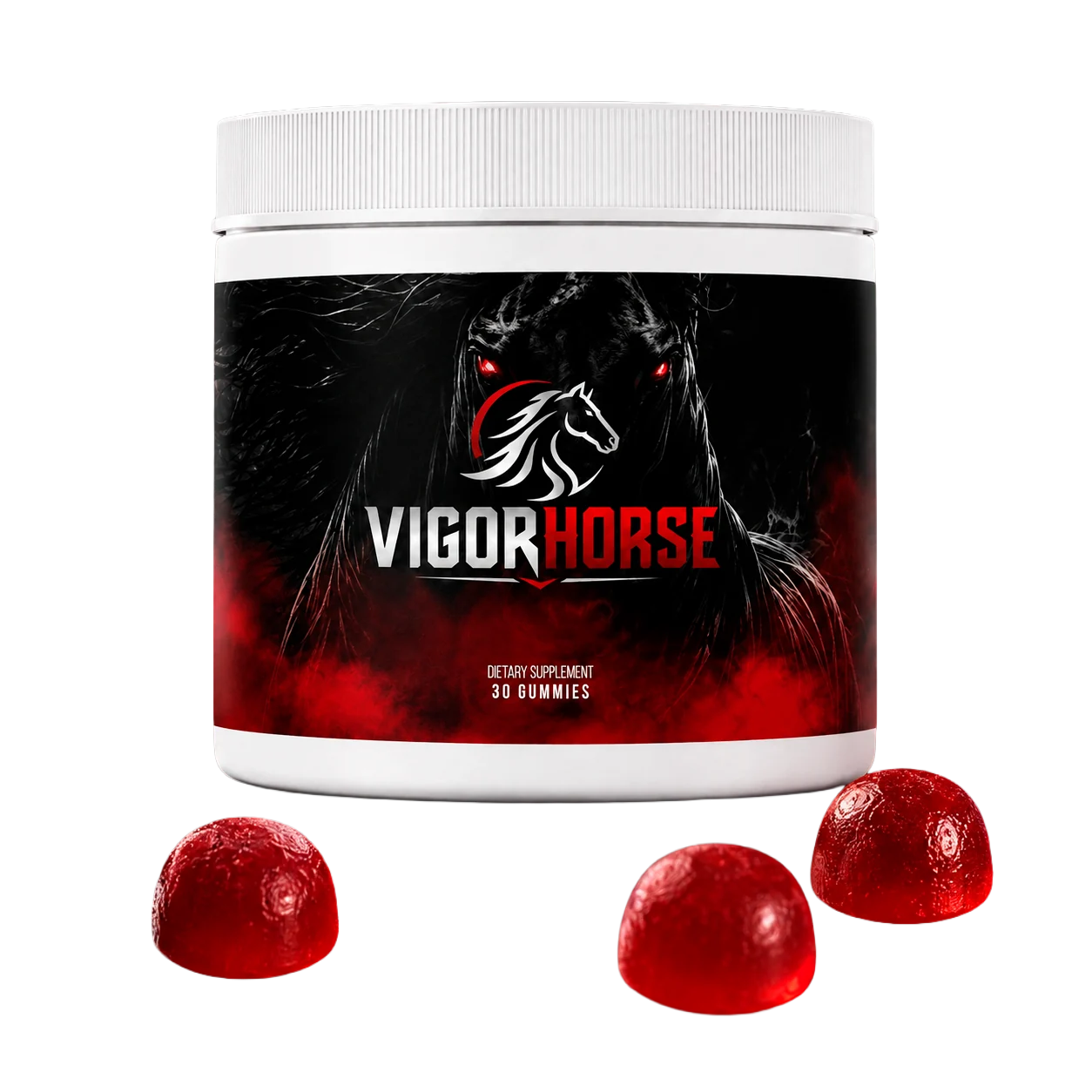
Now read the VigorHorse panel with this guide in hand
A complete printed panel, one 82 mg blend line, and the arithmetic set out where it belongs rather than hidden.
One jar $89 · six jars $294 · 60-day money-back guarantee
Order VigorHorse On The Official WebsiteOne gummy a day · 30 per jar · lot VIG-26/MY-7014