VigorHorse Official Website › Blog › Reading A Gummy Label Honestly
Reading A Gummy Label Honestly
Gummies are the format people actually keep taking, and the format hardest to dose accurately. Both of those are true, and a label reads differently once you hold them together.

- A gummy is mostly its base. The active load it can carry before it stops being edible is small.
- Manufacturing a gummy is pouring and setting a hot syrup, which introduces variability that filling a capsule does not.
- A 2023 JAMA analysis of melatonin gummies found measured content ranging from a fraction of the label figure to more than triple it.
- The advantage is real and often decisive: more people keep taking a sweet than keep taking a capsule.
- Added sugar is the row to read, because it arrives every day the routine runs.
Why format is a real question, not a preference
Most supplement writing treats format as packaging: the same thing in a different wrapper, chosen for taste. It is not. Format decides how much active material a product can carry, how accurately it can be dosed, what else comes with it, and how likely somebody is to still be taking it in eight weeks.
Those four consequences pull against each other, which is why no format wins outright.
| Capsule | Tablet | Chewable gummy | Powder | |
|---|---|---|---|---|
| Active load it can carry | A few hundred milligrams | Up to about a gram | Small, because most of the mass is the sweet | Grams, comfortably |
| Dosing accuracy at manufacture | High, a measured powder fill | High, a compressed measured mass | Lower, a poured and set syrup | High, by weight |
| Sugar and calories | None | Negligible | 3 g and 10 calories on this panel | None |
| How many people keep taking it | Moderate | Moderate | Highest of the four | Lowest, because it needs preparing |
Format comparison rather than brand comparison. Nothing in the gummy column is specific to any one product.
Read across that table and the trade is plain. Powder carries the most and is taken the least. A gummy carries the least and is taken the most. Capsules and tablets sit in between on both.
Which of those matters more depends entirely on what is in the product. For an ingredient with a gram-scale threshold dose, the carrying capacity decides everything and a gummy cannot compete. For a product built around a routine rather than a threshold, adherence is the thing that decides the outcome.
What making a gummy actually involves
A capsule is filled with a measured quantity of a blended powder. The blend can be assayed before filling and every capsule receives a weighed dose. It is a mechanically simple process with few places for a dose to go astray.
A gummy is a hot liquid. Syrup, sugar, water and a gelling agent are heated and mixed, actives are added, and the mixture is deposited into moulds and cooled. Several things can vary: how evenly the actives disperse in the mix, whether any of them are heat sensitive, whether anything settles while the batch is being poured, and how much each deposit weighs.
None of that makes gummies bad. It makes them a process with more variables than a capsule fill, which is exactly the situation where independent testing of finished batches is worth the most.
The measurement study, read carefully
A 2023 analysis published in JAMA bought melatonin gummies sold in the United States and measured what was actually in them. The measured content ranged from a fraction of the label figure to more than triple it.
Two boundaries on that result matter. It tested a different category and a different active from anything discussed on this website, and it does not show that every gummy is mislabelled. What it demonstrates is that the format permits a gap between the printed number and the measured one, and that in at least one product category that gap was large.
- It is evidence about a format, not about any brand, including the one this website sells.
- It concerned melatonin, which is a single synthetic compound and, if anything, easier to dose accurately than a botanical blend.
- It is the strongest argument for third-party testing that exists in this format.
- It is also the reason a lot number matters more here, because a lot is what an assay would attach to.
- And it cuts against over-reading a printed figure, in either direction.
The honest conclusion is a modest one. On a gummy, a printed amount is a claim about what was intended rather than a measurement of what arrived, and the way to close that gap is a certificate of analysis rather than a bigger number on the front of the jar. The analysis of products actually on sale in this category found very few publishing one.
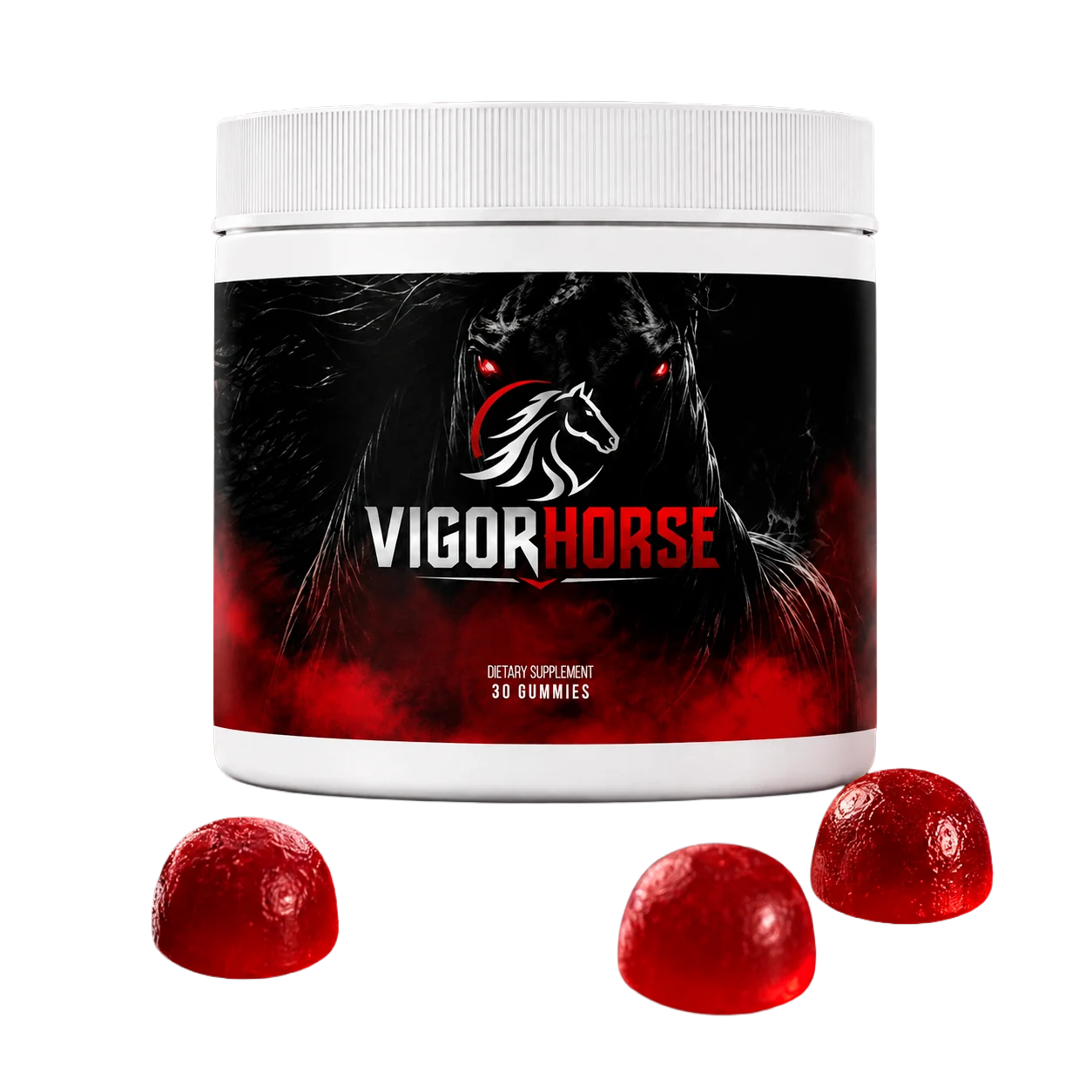
See how the VigorHorse jar reads against all of this
A complete printed panel, one broken-out figure at 5 mg, 3 g of added sugar, and a lot on the base of every jar.
One jar $89 · six jars $294 · 60-day money-back guarantee
Order VigorHorse On The Official WebsiteOne gummy a day · 30 per jar · lot VIG-26/MY-7014
The argument in favour, which is the strongest one available
Everything above is the cost. Here is what is bought with it, and it is worth more than the supplement industry usually admits.
A supplement only works if it is taken. A capsule bottle that runs three months instead of one is a product that has failed, whatever is printed on it, and abandonment over the format rather than the formula is extremely common.
A sweet gets taken. It takes three seconds, it needs no water, it requires no decision, and people who have stopped every capsule they ever bought will finish a jar of gummies. On a panel where the ingredients with any trial record behind them work over weeks rather than days, an eight-week routine that actually happens beats a precisely dosed one abandoned in week two.
A gummy is the right format for a product sold as a routine and the wrong format for a product sold as a dose. A buyer who knows which of those they are buying will not be disappointed by the format.
The sugar row, multiplied out
The one number on a gummy panel that deserves multiplying before it is dismissed is the added sugar.
- Per gummy: 3 g of added sugar and 10 calories on this panel, at 6% of the daily value.
- Per week: 21 g and 70 calories, which is rather less than one can of cola.
- Per jar, thirty days: 90 g and 300 calories, or about a can and a half of cola spread across a month.
- Per three jars: 270 g and 900 calories, still under a single fast-food milkshake in total calories.
For most people that is genuinely small and not worth a second thought. Two situations change it. A diet counting added sugar for a medical reason counts these grams like any others, and a daily sweet is a habit as well as a supplement, which matters if sweets are something you are trying to remove from the day rather than add to it.
Neither is an argument against the format in general. Both are reasons why the sugar row should be read rather than skipped, and why a capsule is the better answer for some people.
Reading the other-ingredients line
On a capsule, the other-ingredients line is usually two or three entries nobody needs to think about. On a gummy it describes most of the product by weight, and it answers two questions people actually care about.
The first is the gelling agent. Apple pectin is a fruit gelling agent and makes a pectin gummy, so the base is not animal-derived. Gelatin does not, and gelatin is the commoner choice. A label naming pectin has answered a question that a great many buyers have, though the absence of a certification mark means it is a description rather than an audited claim.
The second is the sweetener stack. Corn syrup and cane sugar leading the line is the honest explanation for why a gummy tastes like a sweet, and sorbitol liquid, which holds moisture and adds sweetness, is the entry worth knowing about if you are prone to digestive upset from sugar alcohols. A single gummy carries very little of it.
The two entries that are not sweeteners
Citric acid and sodium citrate dihydrate set the acidity and the tartness, and the sodium citrate is where a small sodium figure on the panel comes from. Natural flavors is a regulated collective term rather than one substance, covering flavouring from plant or animal sources without naming them.
Six checks on any gummy label
| What to check on a gummy label | Why it matters on this format specifically |
|---|---|
| Serving size and servings per container | One gummy or two changes every figure downstream, including the price a day |
| Added sugar per serving, and the daily value | It arrives every day the routine runs, and it is the row a sales page is least likely to mention |
| Calories | Small per gummy, and a number worth multiplying by thirty before dismissing |
| Any broken-out ingredient figure | It caps every name printed after it, which is the most useful free inference on a blend |
| The gelling agent on the other-ingredients line | Pectin or gelatin decides whether the base is animal-derived |
| The storage line | A pectin sweet has a real temperature limit that a capsule does not |
Six checks, all readable from the jar in under two minutes.
Those six take under two minutes with the jar in your hand, and between them they settle what the format is going to cost you and what it will give back.
Two more things are worth knowing about the other figures that usually appear. Caffeine safety reviews set 400 mg a day as unremarkable for healthy adults, so a single-digit milligram figure on a gummy is a rounding error in a daily total. And the green tea extract safety literature concerns concentrated extract at hundreds of milligrams a day, which is far above what a small blend total can carry.
A gummy label read this way is not harder to judge than a capsule label. It just asks two extra questions, and both of them are printed right there on the jar.
References
- Cohen PA, Avula B, Wang YH, et al. Quantity of Melatonin and CBD in Melatonin Gummies Sold in the US. JAMA. 2023;329(16):1401-1402. PMID 37097362. https://pubmed.ncbi.nlm.nih.gov/37097362/
- Petre GC, Francini-Pesenti F, Vitagliano A, et al. Dietary Supplements for Erectile Dysfunction: Analysis of Marketed Products, Systematic Review, Meta-Analysis and Rational Use. Nutrients. 2023;15(17). PMID 37686709. https://pubmed.ncbi.nlm.nih.gov/37686709/
- Oketch-Rabah HA, Roe AL, Rider CV, et al. United States Pharmacopeia (USP) comprehensive review of the hepatotoxicity of green tea extracts. Toxicol Rep. 2020;7:386-402. PMID 32140423. https://pubmed.ncbi.nlm.nih.gov/32140423/
- Nawrot P, Jordan S, Eastwood J, et al. Effects of caffeine on human health. Food Addit Contam. 2003;20(1):1-30. PMID 12519715. https://pubmed.ncbi.nlm.nih.gov/12519715/