VigorHorse Official Website › Blog › What A Proprietary Blend Tells You
What A Proprietary Blend Tells You, And What It Does Not
A blend line looks like a wall. It is closer to a ranked list with one number attached, and on a label that breaks out a single ingredient it gives away more than most readers ever collect.
- A proprietary blend is a labelling format written into United States regulation, not a hole in the artwork.
- Its members must be listed in descending order of predominance by weight, so the printed order is a ranking rather than an alphabet.
- The blend carries one total. No single member can exceed it, which fixes a ceiling for every name at once.
- When one ingredient is broken out with its own figure, every name printed after it weighs no more than that figure.
- What the format cannot give you is a comparison against a published trial, because a trial used a stated amount of one thing.
What the format actually is
A Supplement Facts panel normally prints an amount against each active. A proprietary blend is the permitted alternative: a group of ingredients printed under one name, with one total weight, and the members listed underneath.
Two rules govern it and both are worth knowing. The members must appear in descending order of predominance by weight, and the blend must carry its own total. That is it. There is no requirement to say how the total divides, which is the part everybody notices, and no permission to list the members in a flattering order, which is the part almost nobody does.
So a blend line is not a refusal to say anything. It is a refusal to say one specific thing, wrapped around two pieces of information that are stated precisely.
Rank is information, and it is free
Because the order is fixed by weight, the first name on a blend line weighs at least as much as every name after it, and the last name weighs no more than any name before it. That holds whatever the manufacturer would have preferred.
It is the reason a blend led by the cheapest bulk filler is readable as such. If a product is sold on an expensive standardised extract and that extract is printed seventh out of nine, the label has told you where the money went without meaning to.
| The format settles | The format leaves open |
|---|---|
| The rank order of every name in the blend, by weight | The interval between one rank and the next |
| A ceiling: no single name exceeds the blend total | A floor: any name below rank one could be a trace |
| Where a broken-out ingredient sits, when one is printed | Everything above it in amount, which shares the remainder |
| That the manufacturer knows the split | Whether the split resembles any published protocol |
| That the total is what it says it is | How the total was arrived at, beyond an extract-ratio footnote |
Descending order of predominance by weight is the labelling rule for a blend. Everything in the left column follows from it.
The right-hand column is the honest limit. Rank two could sit a milligram behind rank one or most of the way to zero, and the same printed line covers both. Ranking is ordinal, and ordinal information is real without being quantitative.
The inference almost nobody makes
Here is the part that turns a blend line from a wall into a source. When a blend breaks out one member with its own printed figure, that figure caps every member listed after it.
The logic is one step long. The list is in descending order by weight. A name printed later weighs no more than a name printed earlier. So if the fifth name carries a printed 5 mg, the sixth, seventh, eighth and ninth each weigh 5 mg or less. One number, four ceilings.
A blend total tells you the ceiling for nine names added together. A broken-out figure tells you the ceiling for each of the names behind it individually, which is a much sharper constraint and is available on any label that prints one.
Broken-out figures appear more often than you would expect, usually because an ingredient carries its own regulatory or marketing reason to be declared. Caffeine is the commonest: a buyer counting caffeine has a legitimate reason to know, and a manufacturer printing it gains a small credibility point.
Running both rules on one real panel
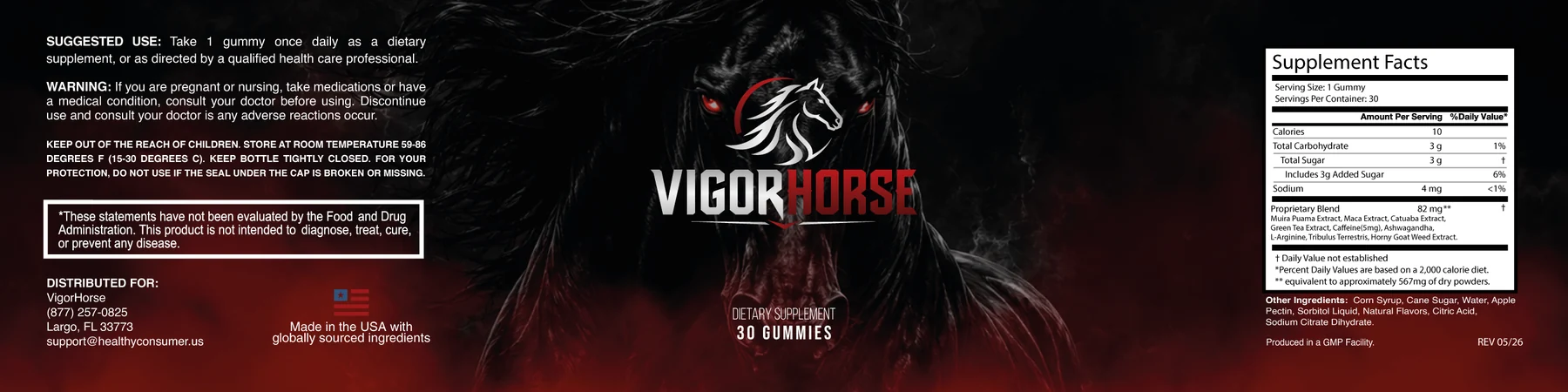
The panel on this website is a clean worked example. It prints Proprietary Blend, 82 mg, with 9 names underneath and caffeine broken out at 5 mg in fifth position.
| Rank | Name as printed | What the rank alone tells you |
|---|---|---|
| 1 | Muira Puama Extract | At least as much as every name below it, and no more than the 82 mg total |
| 2 | Maca Extract | No more than the name above it, and at least as much as the one below |
| 3 | Catuaba Extract | No more than the name above it, and at least as much as the one below |
| 4 | Green Tea Extract | No more than the name above it, and at least as much as the one below |
| 5 | Caffeine(5mg) | No more than the name above it, and at least as much as the one below |
| 6 | Ashwagandha | 5 mg or less, because it sits below the printed caffeine line |
| 7 | L-Arginine | 5 mg or less, because it sits below the printed caffeine line |
| 8 | Tribulus Terrestris | 5 mg or less, because it sits below the printed caffeine line |
| 9 | Horny Goat Weed Extract | 5 mg or less, because it sits below the printed caffeine line |
Read off the printed order and the one broken-out figure. Nothing in the right-hand column is an estimate; it is what descending order plus one number forces.
Read the right-hand column and the panel has told you something specific about four of its nine names without ever intending to. Ashwagandha, L-arginine, tribulus and horny goat weed extract each weigh 5 mg or less in a gummy.
The first four names share whatever is left of 82 mg after caffeine and the four names behind it are accounted for. That is still a range rather than a figure, and it is far more than a blend line is usually credited with carrying.
What an extract-equivalence footnote means
Underneath many blend lines sits a second number. This one reads “equivalent to approximately 567mg of dry powders”, and it is routinely misread as a second, larger dose.
It is a ratio. An extract is a concentrate: raw dried herb is processed down, so a smaller weight of extract can be described against the larger weight of raw material it came from. The footnote is saying that 82 mg of these extracts corresponds to roughly 567 mg of the powders before concentration.
Two things follow. The figure is a total for the whole blend, exactly like the first one, so it attaches to no single name. And it does not add anything to the gummy. There is one quantity of material in there and the footnote is a second way of describing it.
- It is not a hidden extra dose. Nothing is being held back and then declared.
- It is not a standardisation figure. A standardisation names an active fraction and a percentage, which is a different claim entirely.
- It is not per ingredient. Like the blend total, it covers every name at once.
- It is, genuinely, useful context. It tells you these are concentrated extracts rather than milled whole herb, which is worth knowing.
See how the VigorHorse panel reads once you know the rules
Nine actives on one 82 mg line, caffeine broken out at 5 mg, and a jar that is exactly thirty days at one gummy a day.
One jar $89 · six jars $294 · 60-day money-back guarantee
Order VigorHorse On The Official WebsiteOne gummy a day · 30 per jar · lot VIG-26/MY-7014
The four things it still cannot tell you
Everything above is what the format gives. This is what it withholds, and the list is short and absolute.
- How much of any one ingredient you are taking, beyond a rank and a ceiling. The split belongs to the manufacturer.
- Whether any ingredient reaches a dose used in a trial. A trial used a stated amount of one thing; a blend states a total for several, and the two are not commensurable.
- Which member is doing anything, if the product does something for you. A blend cannot be an experiment.
- Whether the split has changed between production runs, since the printed line stays the same either way.
That last one is quiet and real. A label can remain literally accurate through a reformulation that moves a great deal of weight from one name to another, provided the rank order still holds. Nothing about that is illegal and nothing about it is visible.
Why manufacturers use it at all
The stated reason is formula protection: a competitor with a full breakdown can copy a product in an afternoon. That is a real commercial concern and it is the reason the format exists in regulation.
The unstated reason, in some cases, is that a full breakdown would be unflattering. An analysis of the products actually on sale in this category found a narrow ingredient pool at amounts that rarely match the research, and a blend total is a convenient way not to publish nine individually small numbers.
Both can be true at once, and a reader cannot tell from the outside which applies to a given jar. What a reader can do is apply the rank rules, note the broken-out figure if there is one, and read the total against the doses the trials used. The urology ingredient guide does the same arithmetic across the whole category.
How to read any blend line in ninety seconds
- Read the total first. It is the ceiling for everything inside, added together.
- Look for a broken-out figure. If one exists, every name after it is capped at that amount. A caffeine figure is the commonest and the most useful.
- Read the order as a ranking. First is largest, last is smallest, and a marquee ingredient printed late is telling you something.
- Treat any equivalence footnote as a ratio, not as a second dose.
- Compare the total against one published trial dose, not against all of them. One comparison is enough to place the product.
- Stop there. Anything more precise than that is guesswork, and a label that supported more precision would have printed it.
A 2023 JAMA analysis of melatonin gummies measured products whose content ranged from a fraction of the label figure to more than triple it. That was a different category and a different active, and it is a reminder that on this format the printed number and the measured number are two different claims.
None of that makes a blend a bad purchase. It makes it a purchase you should make for the routine rather than for the arithmetic, and knowing the difference is most of what reading a label is for.
References
- Petre GC, Francini-Pesenti F, Vitagliano A, et al. Dietary Supplements for Erectile Dysfunction: Analysis of Marketed Products, Systematic Review, Meta-Analysis and Rational Use. Nutrients. 2023;15(17). PMID 37686709. https://pubmed.ncbi.nlm.nih.gov/37686709/
- Cui T, Kovell RC, Brooks DC, et al. A Urologist's Guide to Ingredients Found in Top-Selling Nutraceuticals for Men's Sexual Health. J Sex Med. 2015;12(11):2105-17. PMID 26531010. https://pubmed.ncbi.nlm.nih.gov/26531010/
- Nawrot P, Jordan S, Eastwood J, et al. Effects of caffeine on human health. Food Addit Contam. 2003;20(1):1-30. PMID 12519715. https://pubmed.ncbi.nlm.nih.gov/12519715/
- Cohen PA, Avula B, Wang YH, et al. Quantity of Melatonin and CBD in Melatonin Gummies Sold in the US. JAMA. 2023;329(16):1401-1402. PMID 37097362. https://pubmed.ncbi.nlm.nih.gov/37097362/