VigorHorse Official Website › Blog › Sleep, Weight And Movement
Sleep, Weight And Movement: What The Trials Say Before Any Supplement
Every supplement trial on this shelf has a quieter rival: trials of things that cost nothing. This is what those trials ran, what they moved, and where the evidence is thinner than the headlines make it sound.
- Pooled trials of exercise, diet and weight loss in men with erectile difficulty land in a narrow band of roughly 2.4 to 3.9 points on the standard questionnaire, and the newest review rates its certainty as moderate.
- One two-year trial in obese men found that about a third of the advised group moved from below the diagnostic line to above it, against 3 of 55 in the comparison group.
- Weight loss is associated with a rise in testosterone in a 24-study meta-analysis, and the more weight lost, the bigger the rise. That finding is about obese men and says nothing about lean ones.
- Sleep is the messy one. Total sleep deprivation lowers testosterone; a few nights of shortened sleep, in two randomised studies and a pooled analysis, did not do so reliably.
- None of this is an argument against a daily gummy. It is an argument for not crediting a jar with what a walk, a few pounds lost or a better night did.
Why this comes before the jar
Most of what is written on this blog asks one question: what did this ingredient do in the trial where it was tested? It is a fair question and it has produced some uncomfortable answers. It also leaves out something. Men who take a supplement for circulation, libido or stamina, which are the supports named for this jar, are usually changing other things in the same month, and those other things have trial records of their own.
So this article turns the question around. What did ordinary, unglamorous interventions do when they were measured against the same outcomes? The results timeline page already tells you that sleep, training and alcohol move these outcomes faster and harder than a shared botanical line can. This is the evidence behind that sentence, laid out so you can weigh it yourself.
A word on the yardstick before the numbers. Most of the trials below report erectile function on the International Index of Erectile Function, usually shortened to IIEF. Higher is better, and the erectile function part of it runs from 6 to 30. If you have never met the scale, the companion piece on running a fair sixty-day test explains what a point means. For now, all you need is that higher is better and that a difference of a point or two is small on a scale that wide. The companion piece has the published threshold for a change worth noticing.
The trial that started the conversation
In 2004, a team at a university hospital in Italy published a randomised trial in JAMA that is still worth reading closely. They took 110 obese men, aged 35 to 55, with erectile dysfunction defined as an IIEF score of 21 or less. None had diabetes, high blood pressure or abnormal blood fats, which is unusual and useful, because it strips out the usual excuses.
Half were given detailed advice on losing at least a tenth of their body weight by eating less and moving more. The other half got general information about healthy food and exercise. Then everybody was followed for two years.
| Advised group (55 men) | Comparison group (55 men) | |
|---|---|---|
| Body mass index, start to end | 36.9 to 31.2 | 36.4 to 35.7 |
| Physical activity, minutes a week | 48 to 195 | 51 to 84 |
| IIEF score, start to end | 13.9 to 17 | 13.5 to 13.6 |
| Men scoring 22 or higher at the end | 17 | 3 |
Figures as the abstract reports them. Single-blind, two years, one hospital.
The authors' own summary is measured: lifestyle changes were associated with improved sexual function in about a third of obese men with erectile dysfunction at the start. Three things independently tracked the improvement in their statistics: the fall in body mass index, the rise in activity, and the fall in C-reactive protein, a blood marker of inflammation.
Notice what the trial is not. It is not a trial of a pill, it ran for two years rather than two months, and the men had to change how they lived. That is exactly why it is hard to imitate. It also tells you where to be careful. A third improving means two thirds did not reach that line, and it says nothing about men who are not obese.
Exercise on its own, pooled twice
Two systematic reviews have pooled the exercise trials, six years apart, and their estimates sit close together.
| Review | What went into it | What it found |
|---|---|---|
| Silva and colleagues, 2017 | 7 randomised trials, 478 men with erectile dysfunction, follow-up from 8 weeks to 2 years | Pooled improvement of 3.85 IIEF points (95% CI 2.33 to 5.37); 3.39 to 4.28 after sensitivity checks |
| Khera and colleagues, 2023 | 11 randomised trials of aerobic exercise against non-exercising controls | Pooled improvement of 2.8 points on the erectile function domain (95% CI 1.7 to 3.9) |
Both are pooled estimates from trials in men who already had erectile dysfunction.
Two details in those abstracts are worth pulling out. First, the 2023 review found the gain was bigger in men who started lower: 2.3 points in mild dysfunction, 3.3 in moderate and 4.9 in severe. That is the ordinary pattern for almost any intervention, and it means a man who scores in the healthy range at baseline has very little room to show a change on this scale at all.
Second, the 2017 review rates the risk of bias in its trials as moderate to high, mainly because nobody can be blinded to whether they are exercising. That does not cancel the result, but it is why the honest description is “improves patient-reported function” rather than “fixes it”, and why the authors single out moderate-to-vigorous aerobic exercise as the type with the clearest signal.
Diet and exercise together, and what the newest review says
The earlier of the two pooled analyses of combined lifestyle interventions came out in 2011. It found six trials with 740 participants, in which lifestyle change, and in two cases drugs for cardiovascular risk factors, produced an average gain of 2.66 IIEF-5 points (95% CI 1.86 to 3.47). With the statin trials removed, the four purely lifestyle trials, 597 men, still showed a gain of 2.40 points (95% CI 1.19 to 3.61).
The newest review, published in May 2026, is the largest. It pooled 16 randomised trials with 1,477 participants who had erectile dysfunction and compared diet-only, exercise-only and combined programmes against usual care or no intervention. The average gain was 2.35 points (95% CI 1.68 to 3.01), and the certainty of the evidence was rated moderate. All three types of programme improved scores, and none was clearly better than the others.
The authors call the effect “modest but significant”, and they add the honest limits: the programmes varied, adherence was reported inconsistently, and some trials mixed clinical populations. One more limit belongs on that list. Every trial here asked men to keep doing something for weeks to years. The effect belongs to the sustained behaviour, not to a week of good intentions.
The 2026 review opens with a sentence that matters more than its numbers: erectile dysfunction is increasingly recognised as a marker of vascular and metabolic health. If difficulty is persistent rather than occasional, the useful next step is a conversation with a clinician, not a shopping basket. That is true whatever is in the basket.
Smoking, alcohol and coffee, from population data
Trials can only test what someone is willing to assign at random. For habits, the evidence mostly comes from surveys. A 2018 meta-analysis pooled 89 population-based studies covering 348,865 people and looked at six lifestyle factors against sexual dysfunction.
- Cigarette smoking had a dose-dependent association: the more smoking, the higher the risk of erectile dysfunction.
- Physical activity also showed a dose-dependent pattern in the other direction: more activity, lower risk.
- Alcohol was curved. Moderate intake was associated with a lower risk, and heavier intake did not share that benefit.
- A healthy diet showed some evidence of a link with lower risk, though the authors flag limited statistical power for diet.
- Caffeine intake was unrelated to erectile dysfunction, again with the caveat of low power.
These are associations, so they cannot prove that quitting smoking or adding a walk causes the difference. They are still the best available description of which habits travel with which outcomes, and they come from a very large body of data. The caffeine line is the one worth remembering if you read this jar's panel: the 5 mg it prints is a small figure, and the population data do not link caffeine to this outcome.
Add a jar last, on a steady baseline
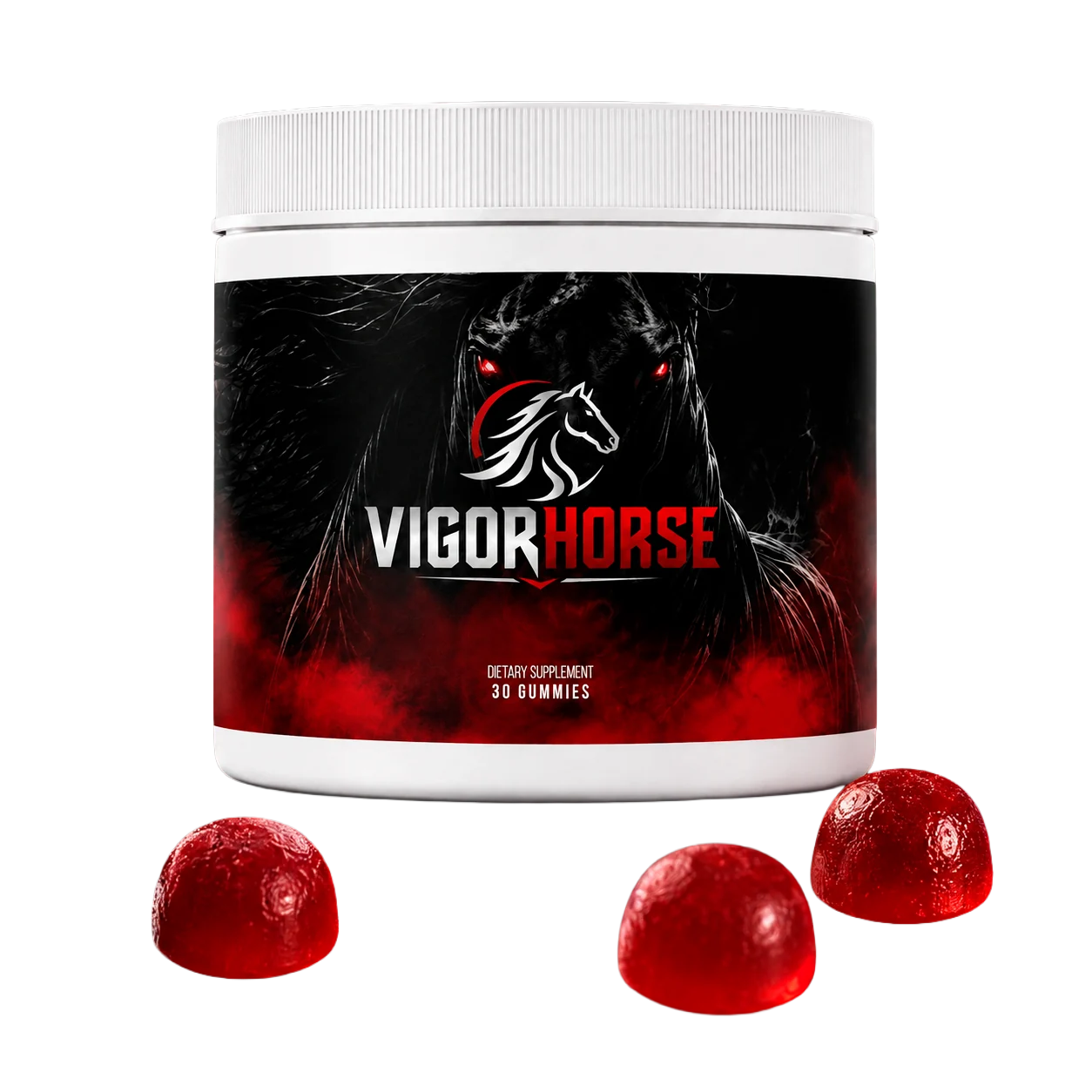
A complete printed panel, 5 mg of caffeine, 3 g of added sugar, and 60 days from the date of purchase to decide whether the routine earned its place.
One jar $89 · six jars $294 · 60-day money-back guarantee
Order VigorHorse On The Official WebsiteOne gummy a day · 30 per jar · lot VIG-26/MY-7014
Weight, and what it does to testosterone
Testosterone is where this category likes to sound scientific, so it deserves a careful paragraph. A 2013 systematic review and meta-analysis in the European Journal of Endocrinology pooled 24 studies of weight loss in men. Both a low-calorie diet and bariatric surgery were associated with a significant rise in testosterone, with surgery producing the bigger rise. The amount of weight lost was the best single predictor of how far testosterone climbed, and the rise was larger in younger men, in men without diabetes and in men who started with greater obesity. Estradiol fell and gonadotropins rose alongside it.
The title says it plainly: weight loss reverts obesity-associated low testosterone. It is a finding about a specific group. It does not say that a lean man can raise his testosterone by dieting, and it does not say anything about a supplement. For comparison, the maca trial that put that ingredient on this shelf measured reproductive hormones and found no change in them, which is set out in the maca article. If the honest route to a better hormone profile for an obese man runs through the scales, a jar is the wrong place to look for it.
Sleep, where the papers disagree with each other
It would be tidy to hand you a clean rule about sleep and testosterone. The literature does not allow one, and it is better to say so than to pick the study that reads best.
A 2021 meta-analysis pooled 18 studies with 252 men. Short-term partial sleep deprivation had no significant effect on testosterone (standardised mean difference -0.22, 95% CI -0.50 to 0.06). Total sleep deprivation did: -0.64 overall, and about -0.67 to -0.74 at 24 and 40 to 48 hours. Its conclusion is that sleep duration plays a pivotal role, but read what was actually pooled: staying awake for a day or two, not sleeping badly for a week.
A pair of randomised studies from 2019 tried the more realistic version. In the first, 14 young healthy men had four hours in bed for five nights against nine hours; in the second, 13 men had mildly shortened sleep for six weeks. The first found no significant effect on testosterone. In the second, testosterone was slightly lower with restriction but rose over the six weeks, and the authors concluded that sleep restriction did not adversely affect it in healthy young men, while noting prior contradicting evidence and calling for confirmation. These are small studies in young men, not in men in their fifties.
Then there is sleep apnoea, which is a different problem from short sleep. A 2018 review of 28 observational studies found that erectile dysfunction was more common in men with obstructive sleep apnoea than in men without it. It is an association, drawn mostly from cross-sectional and case-control designs, and the authors ask for better prospective studies. Loud snoring with unrefreshing sleep is a good reason for a medical conversation regardless of what it does to erections.
What can honestly be said, then, is narrow. Losing a night or two of sleep entirely lowers testosterone. A modestly short week does not reliably do so in young men. Sleep apnoea travels with erectile difficulty. What the record does not show is that one extra hour a night raises anything. Anyone quoting you a precise percentage for what five hours does has read past the disagreement.
The numbers next to a jar
| Intervention | Best evidence | Typical size in the abstracts | How long it ran |
|---|---|---|---|
| Aerobic exercise | Two pooled reviews, 7 and 11 trials | +2.8 to +3.85 IIEF points | 8 weeks to 2 years in the 2017 review |
| Diet, exercise or both | Pooled review, 16 trials, moderate certainty | +2.35 IIEF points | Varied by trial |
| Weight-loss advice in obese men | One randomised trial, 110 men | 13.9 to 17 against 13.5 to 13.6 | 2 years |
| Weight loss and testosterone | Meta-analysis of 24 studies | Significant rise, larger with more weight lost | Diet or surgery |
| The ingredients on this jar | No trial of the finished gummy exists | Not measurable, because the panel prints one total, 82 mg, for nine names | Not applicable |
Sizes are as the abstracts state them, in men who started with erectile dysfunction. The last row is a fact about the panel, not a judgement.
That table is not a fair contest, and it would be wrong to present it as one. The lifestyle rows come from months or years of sustained change in supervised trials. A daily gummy is a small habit with a shared ingredient total behind it, and the honest reading of the proprietary blend article is that nobody can say what any single name contributes. What the table does say is that the sensible place to put your effort first is where the pooled trials are.
There is one more reason to look at it that way, and it is practical. A jar is the cheapest change to make and the easiest to credit. If you start a walk, a lighter dinner, a gummy and an earlier bedtime in the same week, the month afterwards teaches you nothing about any of them. The four measurements on the results timeline page only work if you change one thing at a time.
A sensible order of operations
- If erectile difficulty is what is driving you, get it looked at. The newest review describes it as a marker of vascular and metabolic health, and no article, including this one, can substitute for an examination.
- Put effort where the pooled trials are. Moderate-to-vigorous aerobic activity carries the clearest signal in the exercise reviews, and for men with a body mass index of 30 or more, weight is the variable with both the Italian trial and the testosterone meta-analysis behind it. Agree the plan with your own doctor first if you have any cardiac or other medical history.
- Leave sleep alone as a lever and protect it as a floor. The evidence does not promise a gain from extra sleep, but it does say that lost sleep, and untreated apnoea, are worth avoiding.
- Cut what the population data flag. Smoking has a dose-dependent link in the largest data set on the list.
- Add a jar last, on a steady baseline, and write the day you started next to the four numbers on the results timeline page. Sixty days is long enough to judge a routine, and it is the length the seller's guarantee runs.
None of that is a reason to skip the jar. It is a reason to be the sort of buyer who can tell, at day fifty, whether it did anything.
References
- Esposito K, Giugliano F, Di Palo C, et al. Effect of lifestyle changes on erectile dysfunction in obese men: a randomized controlled trial. JAMA. 2004;291(24):2978-84. PMID 15213209. https://pubmed.ncbi.nlm.nih.gov/15213209/
- Silva AB, Sousa N, Azevedo LF, et al. Physical activity and exercise for erectile dysfunction: systematic review and meta-analysis. Br J Sports Med. 2017;51(19):1419-1424. PMID 27707739. https://pubmed.ncbi.nlm.nih.gov/27707739/
- Khera M, Bhattacharyya S, Miller LE. Effect of aerobic exercise on erectile function: systematic review and meta-analysis of randomized controlled trials. J Sex Med. 2023;20(12):1369-1375. PMID 37814532. https://pubmed.ncbi.nlm.nih.gov/37814532/
- Gupta BP, Murad MH, Clifton MM, et al. The effect of lifestyle modification and cardiovascular risk factor reduction on erectile dysfunction: a systematic review and meta-analysis. Arch Intern Med. 2011;171(20):1797-803. PMID 21911624. https://pubmed.ncbi.nlm.nih.gov/21911624/
- Li T, He X, Huang W, et al. Efficacy of lifestyle interventions in treating erectile dysfunction: a systematic review and meta-analysis of randomized controlled trials. J Sex Med. 2026;23(6). PMID 42143598. https://pubmed.ncbi.nlm.nih.gov/42143598/
- Allen MS, Walter EE. Health-Related Lifestyle Factors and Sexual Dysfunction: A Meta-Analysis of Population-Based Research. J Sex Med. 2018;15(4):458-475. PMID 29523476. https://pubmed.ncbi.nlm.nih.gov/29523476/
- Corona G, Rastrelli G, Monami M, et al. Body weight loss reverts obesity-associated hypogonadotropic hypogonadism: a systematic review and meta-analysis. Eur J Endocrinol. 2013;168(6):829-43. PMID 23482592. https://pubmed.ncbi.nlm.nih.gov/23482592/
- Su L, Zhang SZ, Zhu J, et al. Effect of partial and total sleep deprivation on serum testosterone in healthy males: a systematic review and meta-analysis. Sleep Med. 2021;88:267-273. PMID 34801825. https://pubmed.ncbi.nlm.nih.gov/34801825/
- Smith I, Salazar I, RoyChoudhury A, et al. Sleep restriction and testosterone concentrations in young healthy males: randomized controlled studies of acute and chronic short sleep. Sleep Health. 2019;5(6):580-586. PMID 31416797. https://pubmed.ncbi.nlm.nih.gov/31416797/
- Kellesarian SV, Malignaggi VR, Feng C, et al. Association between obstructive sleep apnea and erectile dysfunction: a systematic review and meta-analysis. Int J Impot Res. 2018;30(3):129-140. PMID 29795528. https://pubmed.ncbi.nlm.nih.gov/29795528/